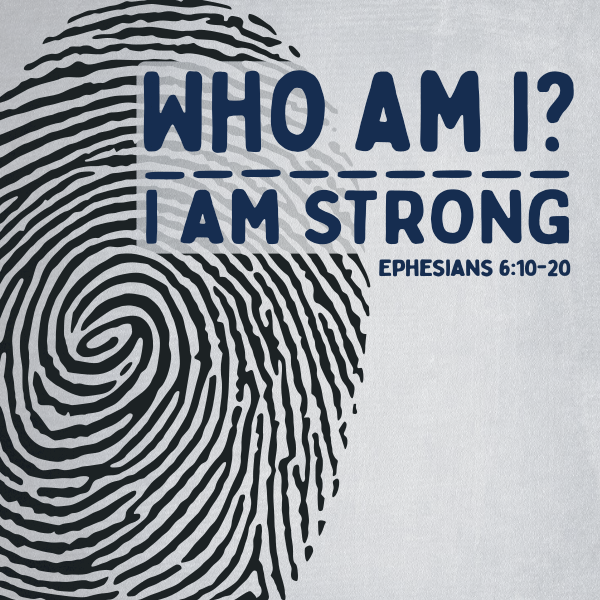
The grand vision of your identity in Christ
Throughout his letter to the Ephesians, St Paul has painted a grand picture of your identity in Christ. You are chosen before the creation of the world. You leave your old life behind as you are made alive. You are united into one body, although you are given a diversity of gifts to build up the church. You are urged to live a holy life as children of light. What a grand vista St Paul has painted! This is who you are. This is who are created to be.
The raging spiritual war
But now, in this final chapter of Ephesians, we are brought down to earth. The harsh reality sinks in. This grand vision is hard work. There is an enemy attacking our identity in Christ. There is cunning opposition seeking to undermine everything. Beneath the surface rages a spiritual war. But this fight ‘is not against human beings. It is against the rulers, the authorities and the powers of this dark world. It is against the spiritual forces of evil in the heavenly world.’ (Ephesians 6:12).
The devil is the personal malevolence coordinating this war. His lies and deception bring pain and affliction. His attacks often target our identity. He causes us to doubt if we really are chosen. He’s a master at dragging up the past, the old life that should be dead and gone. He calls us fakes and frauds, not God’s handiwork and masterpiece. He influences us to act in unholy, impure ways. He sends wave after wave after wave of sickness, disaster, lies, bitterness, rage, anger, harsh words, and all types of evil. One trial after the next. Affliction upon affliction. It’s like we’re in the middle of a mighty river with torrents of water smashing against us, knocking us to our feet again and again. Like the psalmist, we reach breaking point and cry out, ‘Why, LORD, do you stand far off? Why do you hide yourself in times of trouble?’ (Psalm 10:1). Do you, or have you, felt like this?
Be strong … but how?
Then, in the midst of this spiritual battle, St Paul tells us to ‘be strong’ (Ephesians 6:10). It almost sounds like a put down. “Come on now, stop sooking, buck up mate, be strong.” It can almost sound like we need to somehow muster inner strength to fight against the affliction. But where do we get this strength? The torrent is impossibly strong, much stronger than our weak and feeble frames.
Æsop describes this in a fable called ‘Hercules and the waggoner’:
A waggoner was once driving a heavy load along a very muddy way. At last he came to a part of the road where the wheels sank half-way into the mire, and the more the horses pulled, the deeper the wheels sank. So the waggoner threw down his whip, and knelt down and prayed to Hercules the Strong. “O Hercules, help me in this, my hour of distress,” he cried. But Hercules appeared to him, and said: “Tut, man, don’t sprawl there. Get up and put your shoulder to the wheel.”
In saying “Be strong” is St Paul telling us to get up off our knees and put our shoulder to the wheel? Is our God like this fabled Hercules telling us to “Stop sooking, be strong”?
God helps and defends the afflicted
The God revealed to us in Scripture is very different to Hercules in this fable. The psalmist tells us that God sees the trouble of the afflicted (Psalm 10:14), he hears their cry (Psalm 10:17), and he defends them (Psalm 10:18). Our God helps and defends the afflicted.
God does this by giving us his strength — the armour of God. St Paul explains using a word picture of a Roman soldier. We are soldiers fighting in a spiritual war, and we are given God’s armour for our defence. The belt of truth surrounds us. The breastplate of righteousness protects our vital organs. We stand firm on the gospel of peace, the good news that Jesus has come to strengthen us. We have the shield of faith and the helmet of salvation. The only weapon we are given is the double-edged sword that is the Word of God and prayer in the Holy Spirit.
It is through God’s Word and prayer that we are reminded of our true identity. When God speaks his Word he speaks the truth against the devil’s lies. He says, “You are chosen. I have made you alive. You are gifted and created to do good things planned long ago. You are holy, because I have declared you holy through the sacrifice of Jesus. I give you my armour, so let me make you strong.” Prayer then is how we receive God’s strength. Almost the opposite of Hercules from Æsop’s fable, God says, “Get down on your knees in the mud and pray.” Then God himself comes to be with you in the mud through the person of Jesus. And his presence comforts and strengthens you.
Illustration
Let me share a story to illustrate how God gives strength through his Word and prayer. To the best of my knowledge, this story is based on recent, true events in South America:
People traffickers had trapped Mayra, a Honduran woman, and her three children in a southern Mexican house along with a crowd of other migrants. The traffickers had stolen her money and her phone.
Her two-year-old daughter was throwing tantrums and retreating into a shell. Her slender preteen daughter was being groomed for [exploitation], and Mayra’s own pregnant belly continued to swell. She had come this far to save her children from the horrors of her hometown, where three of her siblings and her husband had been murdered. But she found herself paralyzed in a place full of drug use, sexual violence, and noise.
What Mayra felt she could do was pray and sing the praise songs she learned in church, which she converted into whispered lullabies. Huddled on a dirty mattress in a corner, she prayed the “full armour of God” over her children each day for weeks. She tried to shield them with her pregnant body and transform the commanding passage of Ephesians 6 into a blessing: “Be strong in the Lord and in his mighty power.”
[She couldn’t read but] her father, Jorge, had taught her Bible verses when she was young. She held those verses in her heart. “Let us put on the armour of God,” Jorge said each morning and made his family memorize Ephesians 6. They [had] lived in a city where gangs rule. Along with Mayra’s brothers and a sister, who were gunned down, their pastor was killed. Her father became a lay-pastor, and with the “belt of truth” buckled around his waist, preached fiery sermons at church and in local bars. “Our struggle is not against flesh and blood,” he often quoted, “but against the spiritual forces of evil.”
Mayra, now a widow, had managed a fruit stand in Honduras. When the gangs came demanding her service as a lookout she refused, knowing that refusal meant death. The next morning she and her children fled.
In the trafficker’s house in Mexico, Mayra tried to channel her father’s courage, but she wept at night. She had tried so hard to provide for her children but felt that all she had given them was a dirty mattress at the gates of Hell. Then she found a forgotten phone that still had [a few minutes credit]. She dialled Jorge back in Honduras. “Papa,” she said. He was elated. “My daughter, did you make it? Where are you?”
She could barely speak. She had been so strong singing her lullabies and now could not find her voice. Tears rolled down her face. Her father understood. “Repeat after me,” Jorge said. “She who dwells in the shelter of the Most High will rest in the shadow of the Almighty.”
Silence.
“I will say of the Lord, ‘He is my refuge and my fortress, my God in whom I trust.’”
[She made a gasping noise].
“Surely he will save you from the trap.”
By the fourth verse, she was whispering with him.
“Under His wings you will find refuge.”
By the end of Psalm 91, Mayra was speaking again. A wave of peace had come over her. Not the confidence and strength she’d tried to project to keep her children from losing hope, but something more powerful. She took her kids and stepped through the crowded rooms, opened the door, and started walking north. No one stopped her.
[After they had crossed the border, the US Border Control eventually found them and took them to a little Texan border town.] At an icy processing centre with bright lights, harsh voices, and meagre food, Mayra’s children [lay on the cold floor]. She cradled them in her arms and sang.
After enrolling in a tracking system and receiving a date for an asylum hearing, Mayra walked her children out onto the streets of [the little town]. A missionary found them that night on a sidewalk and put them on a bus to San Antonio with [the phone number of a local church].
When they arrived, they had nothing to unpack in their room. [The church] welcomed them with fresh sheets, a warm bath, [food], and some hand-me-down toys. [They] knelt to hear her story. As [they] prayed for her, her shoulders trembled and she wept. [They] wrapped a weighted blanket around her shoulders [as they continued to recite Scripture and pray].[1]
The breastplate of righteousness
We’ve been listening to the music video “You say” by artist Lauren Daigle during communion these last few weeks:
I keep fighting voices in my mind that say I’m not enough.
Every single lie that tells me I will never measure up.
Am I more than just the sum of every high and every low?
Remind me once again just who I am, because I need to know.
When the enemy attacks our identity, it is through God’s Word and prayer that we are reminded of who we are. For me, one of the most important pieces of armour is the breastplate of righteousness. The reason I find it important is that I associate it with baptism. In baptism God declares you righteous. In baptism Jesus gives you his robe righteousness to wear. (‘Righteous’ just means ‘good in the sight of God’). In baptism the double-edged sword of God’s Word and Spirit becomes active in your life.
So let us receive God’s armour and remember who we are. Let us hear God’s Word which says, “You are strong in Christ.” Let us kneel in the mud with Jesus and pray. Heavenly Father: we are weak and under attack. Give us your armour and make us strong, for Jesus’ sake. Amen.
[1] https://www.christianitytoday.com/ct/2019/june-web-only/migrant-san-antonio-border-trauma-therapy.html