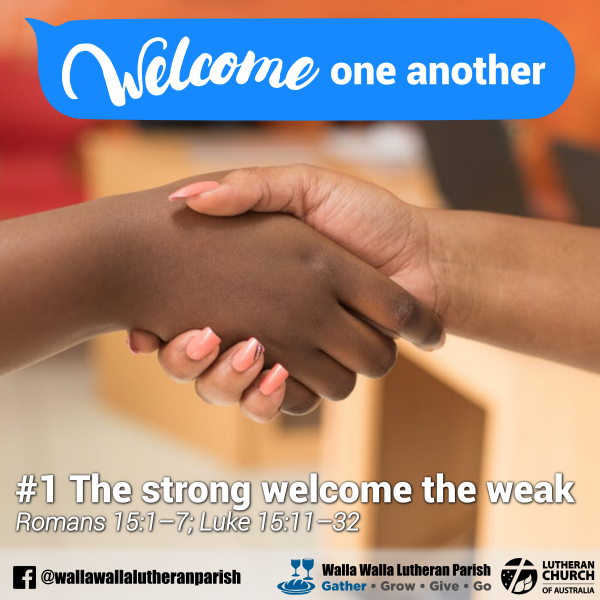
1 We who are strong ought to bear with the failings of the weak and not just please ourselves. 2 Each of us should please our neighbours for their good, to build them up. 3 For even Christ did not please himself. … 7 Welcome one another, then, just as Christ welcomed you, in order to bring praise to God. (Romans 15:1–3, 7)
Introduction
In our new series we’re exploring how we as church welcome one another. We’ll be asking the question: “What does it look like to be welcoming?” What do you picture when I say the word “welcoming”?
The picture I have might sound a bit strange: an older child helping a smaller child in the playground. Imagine you’re back at primary school, playing in the playground. Two bullies come up and start teasing you, hurling insults. One pushes you over into some mud. An older student rushes over and tells them to stop harassing you. He kneels down to help you up. Humbles himself by kneeling in the mud. As he takes you by the hand, the bullies start hurling their insults at him. “Welcoming” means the big guy helps the little guy.
1. What does it mean to “welcome” others?
To “welcome” means to grasp someone’s hand and carry them along. To reach out and grab them when they are falling. To support them in their weakness.
St Paul writes to the church in Rome and encourages them to welcome each other. Writes about two different parties: the “weak” and the “strong.” The weak are those who are, for whatever reason, vulnerable. The strong in contrast have an inner strength at that moment.
St Paul urges the strong to welcome the weak by sharing their strength.
(a) Bear weaknesses.
(b) Not just please self.
(c) Please neighbours for their good, to build them up.
2. Are you “strong”?
The important question: Who are you? Are you the weak or the strong? Are you the little guy, or the big guy?
St Paul writes to the Christian community in Rome saying, “We who are strong” (Romans 15:1). I think the implication is that many of those hearing his letter, and even he himself, are the strong ones. He continues, explaining why, “For even Christ did not please himself. … Welcome one another, then, just as Christ welcomed you.” (Romans 15:3,7).
Jesus has made you strong. He has born your weakness on the cross (Isaiah 53:4). The insults deserved for you have fallen on him (Psalm 69:9). Christ did not please himself, but emptied himself and made himself nothing for you (Philippians 2:7). He grasps your hand when you are falling, and supports you in your weakness. Jesus spreads his pierced hands wide open and wraps his arms around you in a big ‘welcome home’ hug. You live each day knowing what it’s like to have a strong one carry your weaknesses. To have someone kneel down in the dirt with you and pick you up.
This doesn’t mean you won’t have bad days or seasons, when you feel weak. But it does mean that you have a big guy always supporting you.
St Paul concludes that we have “a duty,” “an obligation,” that we “ought” to carry the weak. We are freed, then given a lifelong purpose to serve our neighbour. How will you serve your neighbour? How will you turn from pleasing yourself and instead seek to please your neighbour, for their good?
3. How can we welcome the “weak”?
(a) Children & young people. What might our worship look like if we carried the burdens of children? What might happen if we practiced showing genuine interest in the lives of young people? As a young person I remember one particular church member who would check in with me every Sunday how my week had gone.
(b) Irregular attendees. Imagine if instead of chiding irregular attendees, we put ourselves in their shoes? What if we gently enquired after what prevents their attending? What if we offered to help free up time in their lives? Or took the Word to them?
(c) Unchurched. How might we make unchurched people feel welcome? It’s more than writing “All welcome” on a street sign! One pastor writes that his church has seen an influx of unchurched people (up to 30%) — people who haven’t grown up in the church, who don’t know our traditions and practices. He notes that the singing has changed in his church, with the band really leading the singing — unchurched people rarely sing and are not comfortable singing in public (outside of church we perhaps sing the national anthem or when the foot team wins). How might we need to accommodate unchurched people with different experiences to us?
(d) The ‘little guy’ in our community. Poor. Elderly. Sick. Widows. Orphans. Homeless. Refugees. How might we welcome the ‘little guy’?
Conclusion
We are the body of Christ. Each of us has a different part to play in welcoming others. Hands might welcome children, ears welcome irregular attendees, feet welcome refugees. Who is God calling you to welcome? How are you going to welcome them during the next week? Month? Year? What good work has God prepared for you?
God does not need our good deeds, but our neighbour does. Let’s be Christ to our weaker/struggling neighbours and welcome them with open arms. It cost Jesus a lot to welcome us, what might it cost us to welcome one another? What might it cost you?
Blessing
May the God of steadfastness and encouragement grant you to live in harmony with one another, with one mind in Christ Jesus. May we be humble and seek to please others. May we always look for the good of our neighbours and not our own good. May we build up others for their sake. When we fail in this calling, may God welcome us back with his open arms spread wide on the cross. As we welcome one another, may we glorify the God and Father of our Lord Jesus Christ now and forever. Amen.