How would you describe God in 50 words or less?
What if I asked you to write a short statement describing God? How would you sum up God in 50 words or less? It’s really hard to be short!
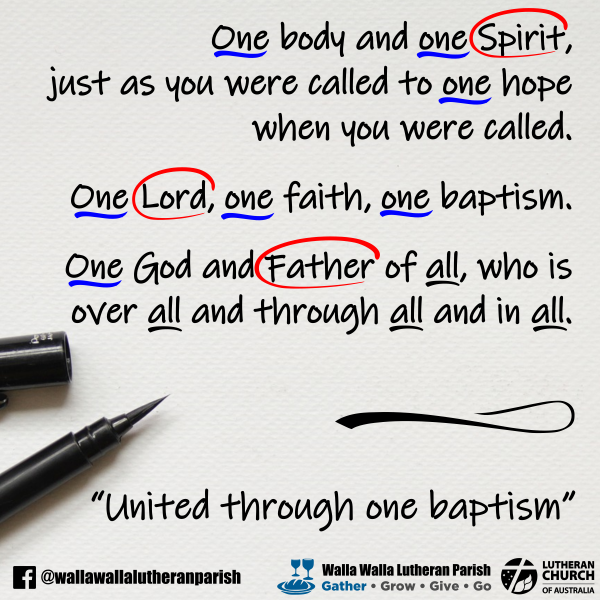
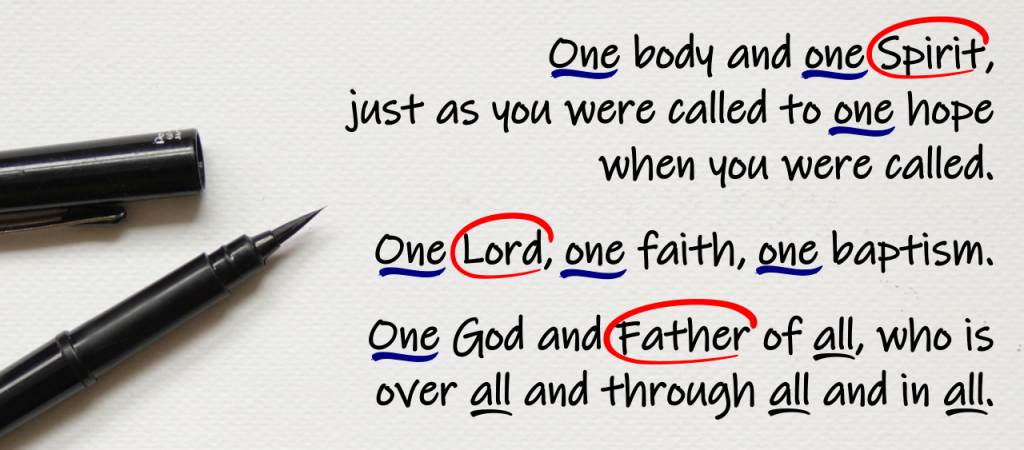
In our second reading from Ephesians chapter 4, St Paul writes a short poem about God. This is called a “confession of faith” or “creed.” In English it’s about 40 words long (or 34 words in the original Greek).
There’s two really interesting things to note about Paul’s concise statement about God.
1. God is Triune
Paul writes about the Triune God: Spirit, Lord (i.e. Son), and Father. “Triune” comes from “tri” (three) and “une” (unity) — “three in union.”
(a) Starts with ‘one body and one Spirit.’ Through the Spirit the church is one body made up of different parts. The Spirit calls us to ‘one hope.’ This hope is not just optimism for the future, or wishing for different circumstances, but “eager expectation” — like a child waiting excitedly through the long Christmas Eve night for the morning to arrive. We eagerly wait for all things to be made new, we hope & expect God’s kingdom to come and God’s will be done on earth as in heaven.
(b) Continues with ‘one Lord’ (i.e. the Son). One of the earliest Christian creeds was the statement “Jesus is Lord.” So here Paul is talking about Jesus, the Son of God, the second person of the Trinity. But it’s interesting he emphasises one Lord. Paul was very familiar with Ephesus and the fact they had many lords (gods and idols). In Acts 19 (verses 23–41) we hear that Paul caused a riot in Ephesus because he threatened the business of the local silversmiths (who built shrines to the goddess Artemis). In the face of these idols, Paul boldly says there is one Lord, one person to devote your entire life. Likewise in our day and age, we have different people and things vying for our attention, man-made idols trying to captivate us. Two come to my mind: property (bigger, better, best); and reputation (being seen to do the “right” thing). These can easily become our lords, yet we are called to declare that there is one Lord. It is the one Lord in whom we have ‘one faith.’ The word “faith” just means to trust. There is one truth that is completely dependable and trustworthy: Jesus Christ died and rose again, and he said this is for the forgiveness of sin, to bring about the coming of God’s kingdom. Trusting in this truth is the ‘food which endures to eternal life’ (John 6:27). Paul concludes this centre section by saying there is ‘one baptism’ — but we’ll come back to this in just a moment.
(c) Finishes with ‘one God and Father of all.’ In just a few words Paul says so much about the Father. ‘Over all’ speaks about God’s distance from us (transcendence) — God the Father is the creator of all, he is distinct from his creation, he sits on his throne in the heavenly realms and rules over all things, he is in control, he is absolutely powerful, he knows everything, he is completely other from us, his ways are beyond our reach. Yet in the same breath Paul declares that God the Father is ‘in all.’ This speaks about God’s nearness to us (immanence) — God is in everything, in the smallest atom in the trees and earth outside, he’s here in the building with us, sitting in the pew next to you, he’s inside you, every one of your cells and your entire body. Wherever you go, whatever situation you find yourself in, God is near, he is in all. So God our Father is further than we can comprehend, and at the same time nearer than we imagine!
Let me explain this tension with a story. During World War II, a farmer and his wife heard word their only son had been killed in action. A priest was called to the home of the grief-stricken parents. The father, pacing the floor, weeping, demanded in anger, “Where was God when my son was being killed?” Silence prevailed. Then the priest replied, “I guess He was with His Son when he was being killed.” God is over all, he’s in control, yet we can’t understand his ways; and at the same time God is in all, through his Son Jesus, he is nearer than we imagine.
2. The church is to be united
Like God who is three persons united in one, the church is to be united. Paul uses the word “one” seven times to make the point. Earlier Paul says, ‘make every effort to keep yourselves united in the Spirit, binding yourselves together with peace’ (Ephesians 4:3). Later, he encourages the church to reach ‘unity in faith … so that we will be mature in the Lord. … Then we will no longer be infants, tossed back and forth by the waves, and blown here and there by every wind of teaching and by the cunning and craftiness of people.’ (Ephesians 4:13–14).
Can you picture the scene? We are like a boat on rough seas, the wind whips up the waves, water crashes into the hull tossing each person back and forth. Paul encourages the church to be united as one body, so that when the next cunning idea, the next fad sweeps through, the church is not tossed to and fro, but stands together, helps each other, supports each other as we grow to maturity in Christ.
But how? How can a bunch of individuals, each with different opinions, experiences, and preferences, be united? The key I think is the climax to the centre of Paul’s beautiful poem: ‘one Lord, one faith, one baptism.’ We are united because we share one baptism. Baptism is the glue that binds us together. Notice there’s not as many baptisms as there are individuals, but one baptism. That’s because baptism means being joined with the one death and resurrection of Jesus. In baptism we participate in Jesus’ crucifixion and resurrection: we are plunged into the water and die, then drawn out to new life. All of us individuals have this one experience joining us with Jesus’ death and resurrection.
Just as baptism is a free gift given to us, the unity of the church is a free gift given by God — unity is not something we can will ourselves. God gives us the gift of a common identity, a shared experienced that ties us all together. I had the privilege of experiencing this unity in a special way when I lived in Europe. I moved there with my wife after university — we knew no one, we didn’t speak the language, we were somewhat lost. In our second week we attended an English speaking church — there were people from all over the world (Germany, Poland, Spain, UK, US, Brazil, Australia). Yet as soon as we walked in the door, we had a family, we had a connection with these apparent strangers!
Maybe you’re sitting here today and you’re not baptised, but you want this gift of a common identity that binds us together. If so, then please talk to someone about baptism (a Christian friend or myself). For those already baptised, I urge us to remember our baptism. We may disagree at times, we may not always see eye to eye, yet God has acted in our lives, and through one baptism joins all of us to the death and resurrection of Jesus. This act of God’s love transcends any differences we may have and binds us together in peace. So let us live each day in that peace, bearing each other in love.
Blessing
May the one Spirit bind you together as one body in peace. May you eagerly anticipate the coming kingdom as we share one hope. In the midst of man-made idols, may you declare that Jesus Christ is the one Lord. May your trust and knowledge of the one faith grow as you live each day joined with your Lord and each other in one baptism. May the one God and Father reveal himself as being both over all and in all — further than you can comprehend, and nearer than you can imagine. Amen.