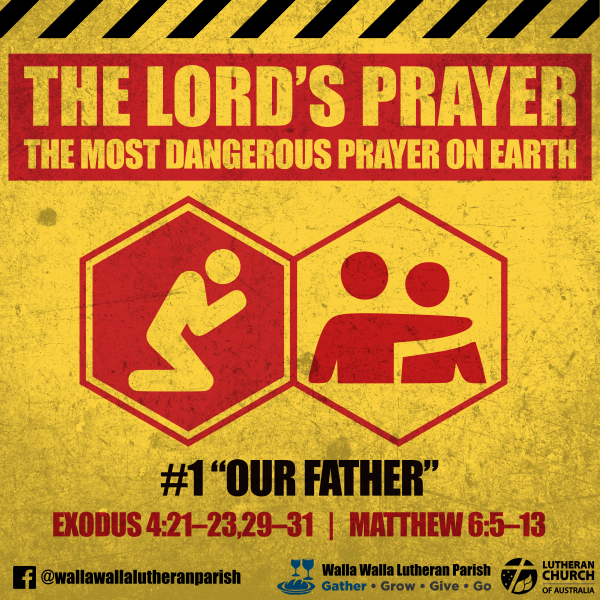
Series introduction
What is prayer? Can anyone do it? And are there any side effects?
Over the next five weeks we’re going to explore the Lord’s Prayer. We’ll hear that in some sense prayer is dangerous, and that makes the Lord’s Prayer perhaps the most dangerous prayer on earth. The simple words of the Lord’s Prayer are subversive, designed to infiltrate our hearts. As we pray, Jesus invites us to breathe in his missional agenda, he invites us to see the world as he sees it.
Now if you want to stay exactly as you are, then *don’t* pray this prayer! But if you want to be transformed, if you desire to see the world in a totally new way, then I dare you to pray the Lord’s Prayer.
If you don’t know what prayer is, then this series is for you. If you want to be drawn deeper into the mission of Jesus and learn to see the world through his eyes, then join us these next five weeks.
Join us as we practice the Lord’s Prayer, and as we hope and expect Jesus’ mission to subvert our own lives, and then the entire world through us.
We pray: God your word is truth, make us holy by your truth. Amen.
What kind of father is God?
Jesus teaches his disciples to pray. He begins with the words “Our Father.” Jesus invites us to call God “Our Father.” So does this mean God is like our earthly fathers?
Our earthly fathers can sometimes be:
(1) Authoritarian. Such fathers lay down the law, and there’s a punishment when we break the rules. Is God an authoritarian Father? I mean God is an infinitely holy being of mystery and majesty we cannot fathom. In contrast we are unholy and impure; we deserve God’s wrath and punishment. In prayer we enter into the presence of God. Do we really want to enter into the presence of a holy and almighty Judge? Sounds dangerous!
(2) Neglectful, abusive. Is God a neglectful or abusive father? At times the world seems like a dreadfully “unfatherly” place, full of suffering and death. We might ask: “How, O Father, if you do exist, how can you allow such disastrous things to happen? How can you allow cancer and drought and stillborn babies and endless rows of graves? Why should we believe that you are our Father? If God is our Father, why doesn’t he act like one and put an end to suffering and death?!”
“We are all orphans. We would like to have a Father, but everything in the world seems to indicate that we do not have one.” (Helmut Thielicke).
(3) Distant, absent. Is God a distant or absent father? Perhaps we think God is up there, “up in the starry vault,” locked away far from us wanting nothing to do with us?
God is our true Father
Our earthly fathers are a shadow of our true Father in heaven. Through the Lord’s Prayer, Jesus invites you to see the world through his eyes, to see God as “our Father.” This too is dangerous, perhaps radically different from our conception/s of God.
(1) God is not authoritarian; but shows tender compassion and mercy (Psalm 103:11). St Paul tells us there is no condemnation for those in Christ Jesus (Romans 8:1).
(2) God is not neglectful or abusive. “God” doesn’t send cancer, “God” doesn’t send drought, and “God” doesn’t send death. These evils exist because of sin and the devil — they are the effect of this broken world.
God, in his infinite wisdom, may allow these things to happen, but that doesn’t mean he is the cause. Even us mortals can sometimes grasp why God performs this “alien” work (to borrow a phrase from Martin Luther). Our Father doesn’t cause suffering and death, yet He still uses these means for our good. That God our Father is the giver of good gifts (Matthew 7:11) is a confession of belief. I find it helpful to think of Jesus’ death — did God will for the priests to turn on Jesus, for Judas to betray his friend, for Jesus to be whipped, mocked, nailed to a cross? In one sense yes, but in another sense no. If there was another way, God would have taken it. But this was the only way, so God our Father turned these horrible events into something beautiful!
(3) God is not distant or absent. Rather, like the father in the parable of the prodigal son (Luke 15:11–24), He’s eagerly looking for ways to demonstrate his unconditional love. If only we let him, if only we have eyes to see. God is close to us. He wants to be so close that he sent His Son, Jesus, who was named “God with us” (Immanuel).
Waiting & hoping
Prayer is not some super “spiritual” activity meant to elevate us to heaven, away from this earth, away our bodies or suffering. In the Lord’s prayer, we pray “on earth as in heaven.” Prayer is about God coming down to earth. Prayer is about us receiving God and the gifts He offers. Prayer is about being with the God who has come to sit with us in the dirt and dust. And as we sit together, we eagerly wait and hope for our rescue.
The story of the Israelites shows that our hope is not in vain. God has everything in control. In the book of Exodus we encounter the Israelite people who have grown numerous in Egypt, but enslaved. God knows the need of his children (Exodus 4:21–23). He sees their misery, and has tender compassion & mercy on his “firstborn son.” God miraculously rescues his son from Egypt — called the “Exodus.”
But that’s not the end of the story. The Jewish people were waiting and hoping for a new and greater Exodus. God had promised He would raise up a new prophet, like Moses (Deuteronomy 18:17–18).
He would again deliver them from oppression, making a way through the “wilderness” (Isaiah 43:16–19). In Jesus’ day the people were still waiting and hoping for the “advent” (coming) of the Messiah, the Christ.
When Jesus invites his disciples — us — to pray “Our Father,” he’s evoking all this history and imagery. We are enslaved in Egypt, languishing in a foreign land. We are suffering. We are dying. Yet God the compassionate Father looks down on his firstborn son, his people — you, the church — and promises a new and greater Exodus. Jesus is the fulfilment of God’s promise. Jesus, the prophet like Moses, rescues you.
So what is prayer? Prayer is taking up Jesus’ offer to see God as our true Father. Jesus dares us to pray to our compassionate and merciful Father. He’s the giver of good gifts, despite appearances to contrary. He’s not distant but always with us through Jesus. In fact as we pray “Our Father” we can almost sense Jesus sitting with us in the dirt and dust, leading us in the words. Together we wait and hope for the new and greater Exodus, the realisation of the rescue mission God our Father has mounted through Jesus. Amen.