In our travels we pass through different landscapes. Coastal regions and rain-forests, green meadows and quiet waters, cities and deserts. On our path to Bethlehem on this Third Sunday of Advent, Isaiah has us travelling through a desert (Isaiah 35:1–7). A parched land, with burning sand and thirsty ground. Travelling through a desert or wilderness place is a metaphor for difficult times in our lives. A desert place is where we question our faith, we thirst for answers, we suffer and doubt.
In our gospel reading, John the Baptiser is in a wilderness place (Matthew 11:2–11). John had been appointed as the special prophet to announce the Coming One, the Messiah. He has preached boldly, “Repent, for the kingdom of God has come near!” (Matthew 3:2). But now John sits in prison awaiting trial. John is wondering if he’s got the right guy. Is Jesus who he said he is? John’s probably thinking, “What kind of kingdom was I preaching? Here I am sitting in prison, in chains, suffering — is this what citizens of Jesus’ kingdom can expect? Is Jesus really the One who was supposed to come? Or should I look for someone else?” (Matthew 11:3). John is full of doubt and fear, his knees are unsteady, he is weak. He is in a desert, a parched land, thirsty for answers.
But this isn’t just John’s question, is it? This question is yours and mine too. This question marks what might be called a ‘faith crisis.’ A time of doubt. A time of testing in the wilderness. In such a crisis, our object of faith is questioned. The one we trust is put to the test. Why believe Jesus and not one of the many other gods or gurus? Why believe when things are bad? Why believe when we’re surrounded by injustice?
Why believe when (such and such) has happened?” (You can fill in the blank for yourself). Is Jesus really the One? Or should we look for someone else?
I’ve been through a few faith crises so far in my life. The biggest one, which lasted a few years in my early twenties, was precipitated by two events. The first was the death of my father due to a brain tumour. Some months afterwards I was doing something and I needed help, so I thought, “I’ll ask Dad.” Immediately I caught myself and realised I couldn’t ask him. And the weight of his death crashed down on me. Why God did you take him? If you are God and in control, why did you let this happen? At the same time, I was studying at university. And I was being confronted with new ideas. Ideas about science and religion, evolution and creation, philosophy and metaphysics. Ideas that challenged my understanding of God and Scripture. I was asking: Is Jesus really the One? Or should I look for another?
Have you been through a crisis of faith? A desert of doubt?
Isaiah then describes something absurd and amazing. ‘The desert and the parched land will be glad; the wilderness will rejoice and blossom.’ (Isaiah 35:1). Burning sand is cooled by bubbling springs of living water, weak knees are strengthened. There is rejoicing and shouting. Gladness and joy overwhelms the weary travellers. How can it be that this dry wilderness — a place of suffering, questioning, and doubt — is transformed into a place of rejoicing? What is it that takes place to bring this grand reversal?
We hear the answer in verse 4. Isaiah says, “Be strong, do not fear; your God will come … he will come to save you.” (Isaiah 35:4). When you are in the wilderness, when you are most in need, when you are crying out for help, this is when God comes to you. God’s presence comes to save you in the desert. It’s only when we are thirsty that Jesus can provide living water. It’s only when we are weak and helpless that Jesus can strengthen our wobbly knees.
Or we could flip it and put it another way. If we are proud and arrogant, we have no need for God, because we’ve (supposedly) got everything under control. If everything is going to plan, we don’t need anyone to rescue us. If everything is well and good in the world, what need is there for Jesus to die and rise again to mend the brokenness and atone for sin?!
The Advent and Christmas message is that Jesus comes for those who are in the wilderness. He comes for the anxious, depressed, lonely, tired, and despairing people. It’s when we are imprisoned, thirsty for answers, parched for truth and justice that Jesus comes to us. To the heart which cries “God where are you? You seem far away, I cannot reach you!” the answer is, “You do not have to reach me; I will come to you.” And so God comes to you. But he comes to you in weak ways. In a manger, not a palace. On the cross, not a throne. In suffering, not in glory. In simple words of forgiveness. In bread and wine.
It’s unfortunate that faith and doubt are often falsely contrasted as opposites. Sometimes doubt is wrongly said as unhealthy or contrary to faith. But this is not the case. Doubt is not the opposite of faith. Let me say this again, clearly: it is okay to have times of doubt. In fact, faith can be strengthened when we walk through deserts of doubt. One theologian puts it like this: ‘Sometimes I hang on to my faith by my fingernails. Doubt is compatible with faith, and we should not be ashamed of it. … Faith is always accompanied by doubt, not least because it [faith] has to be sustained moment by moment.’ (Anthony Thiselton, 2017. ‘Doubt, Faith, and Certainty,’ Eerdmans, page 37). It is in times of doubt, questioning, and suffering — by walking through the desert — that our faith is tested, proved genuine, and in fact ultimately strengthened.
This has certainly been my experience: as I grappled with my questions, my faith grew and became more robust. The key is to do what John did, and bring our doubts and questions to Jesus. Jesus says to John (via his disciples): “Blind people receive sight. Disabled people walk. [The sick] are healed. Deaf people hear. Those who are dead are raised to life. And the good news is preached to those who are poor. Blessed are those who do not give up their faith because of me.” (Matthew 11:5–6). Notice where Jesus says to look for his kingdom: among the blind, disabled, sick, deaf and dead people.
It’s as if Jesus says, “If you want to know if I am really the One, then look in the right place. If you’re expecting a kingdom that rewards the rich and powerful, that promises success and good health, then look for someone else. But if you’re weak, if you’re fearful, if you’re anxious, if you’re poor, if you’re thirsty, broken, or dead — then I’m your guy. Look for me in a manger.”
Now, walking through deserts of doubt doesn’t mean we’re miserable all the time! The picture Isaiah paints is that the desert will bloom and be filled with shouts of joy, the wilderness will rejoice and blossom. God’s presence, even in the desert, brings joy. “Joy to the world, the Lord has come.” Jesus brings the kingdom of heaven to earth, Jesus brings God’s joy to earth.
So this week, even if you are in a desert of doubt, may you have joy in God’s presence. Our Advent calendar has some wonderful ideas to make this happen.
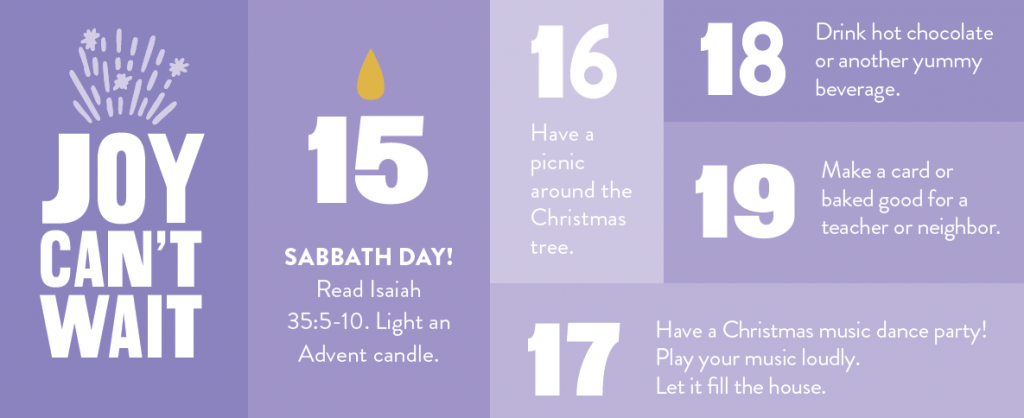
December 15 — Read Isaiah 35. ‘Happy … is the one who meditates on the [Word] day and night.’ (Psalm 1:2). God’s transforming and joyful presence is with us when we hear the Word (just as John heard Jesus speak to him).
December 17 — Have a Christmas dance party. ‘Happy are those who dwell in your house; ever singing your praise.’ (Psalm 84:4). God’s transforming and joyful presence is with us when we sing praises and worship him.
December 19 — Make a card or baked good for a neighbour. ‘Happy are those who have regard for the weak.’ (Psalm 41:1). God’s transforming presence is with us when we care for the poor.
May Jesus come to you in your desert places. May he turn your deserts of doubt into flowering fields of faith. In your times of doubt and questioning, may God’s presence bring you joy. Hear his word of love and comfort. Hear that your sins are forgiven. Serve the poor. Joy to the world, for the Lord has come. Amen.