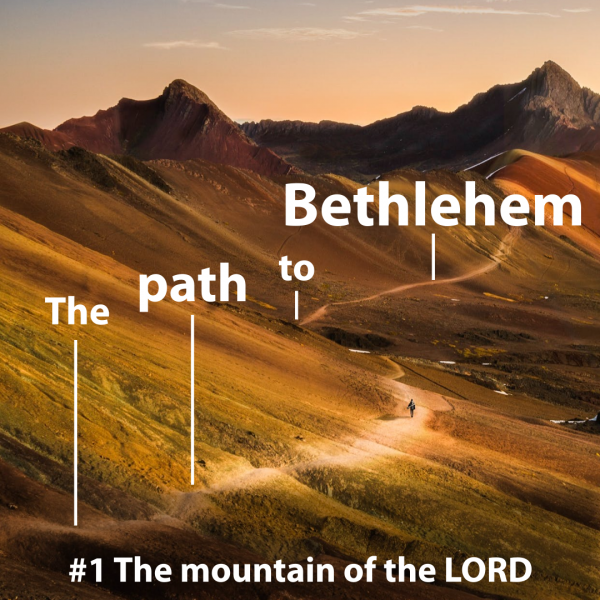
I like to walk. One of my regular walks is from my home (the manse in Walla Walla) up to the mobile phone tower on the top of “Busters Hill” (also known as “Wegener’s Hill”). Here’s a short time-lapse video of this walk.
There are many interesting things to see along the path: there are signs, the hill can be seen from the distance, there are landmarks like corners and tree stumps, signposts mark the way, then finally the ascent and the view from the top.
The season of Advent is like my walk up “Busters Hill.” In Advent we start on the path to Bethlehem and the coming of Jesus at Christmas. When you walk up a hill or mountain, you can see your destination from some distance away. A hill or mountain is usually visible from far off. It juts out from the landscape. A mountain is a place that is ‘exalted above the hills’ (Isaiah 2:2). You can see where you are heading and you anticipate your destination. So we begin our Advent journey by anticipating our destination.
Our path leads us to two destinations. The first destination is the first coming of Jesus at Bethlehem. Each year we relive the Christmas story. We participate as we retell the events of that first Christmas. We walk with Mary and Joseph as they travel to Bethlehem for the census. We run alongside the shepherds as they race to the town after hearing the angels sing of the promised saviour. We journey with the Magi as they come to lay their gifts at Jesus’ feet. The word “Advent” simply means “coming.” Advent is a time we remember and prepare to meet God in the person of Jesus as he comes to earth today.
The second destination we are walking toward during this Advent season is the second coming of Jesus in the last days, at the end of time. The prophet Isaiah says:
In the last days
the mountain of the LORD’s temple will be established
as the highest of the mountains;
it will be exalted above the hills,
and all nations will stream to it. (Isaiah 2:2)
Mountains were considered the meeting place between heaven and earth. And the temple is a sign or symbol for God’s presence. So by saying the LORD’s temple will be built on the highest mountain, Isaiah is describing God’s second special coming to earth.
Isaiah continues by describing what God’s coming presence will be like:
[The LORD] will judge between the nations
and will settle disputes for many peoples.
They will beat their swords into plowshares
and their spears into pruning hooks.
Nation will not take up sword against nation,
nor will they train for war anymore. (Isaiah 2:4)
What a wonderful picture! This second coming will be a time of peace. No more war. No need for swords or spears. Imagine a time when you check the news and there’s no disputes, no conflict, no war. Imagine going to work, or being home with your family, and there’s no yelling, no fights, no disagreements, no misunderstandings. Instead there is complete justice and peace. Swords beaten into farm equipment.
These are the two destinations that are in view during Advent: God’s coming in Jesus at Bethlehem, and God’s coming in the last days. I’ve heard it put like this: Advent is about participation (we participate in the first coming of Jesus) and anticipation (we anticipate the second coming of Jesus).
When you walk or travel somewhere, you anticipate the destination. You hope for your arrival. Think about kids travelling in the car to a holiday destination. They’re bouncing off the walls, you can hardly strap them into their seats. You get five minutes down the road when the chorus rings out from the back seat, “Are we there yet? Are we there yet?” They are anticipating the destination and hoping to arrive.
Or think about my walk up “Busters Hill.” As I’m walking I look up at the mobile phone tower in the distance. I hope for and anticipate reaching the top: I can take a rest, catch my breath, and soak in the views.
It’s the same with Advent. We hope for our destination. We anticipate Christ’s coming. We look forward to Christmas Day. Yes, there are presents and parties, family and fun. Yet it is that special time of year to encounter God’s presence in Jesus as he comes to earth for you. We also anticipate and hope for the last days, when the LORD will establish his temple on the mountain and His presence will dwell on earth in a new way with complete justice and peace.
But in the meantime we’re trudging along the path. The mountain seems far away. We take a second look. “Is that it?” we think. I mean “Busters Hill” is hardly Mount Everest, is it?! As mountains go it’s pretty insignificant. The temple Mount, Mount Zion in Jerusalem where the Israelite people built the physical temple, is likewise insignificant. It’s not the ‘highest of the mountains, exalted above the hills.’ In fact, the Mount of Olives is higher. And other nearby mountains, such as Mount Hermon, are much taller, not to mention many other mountains around the world.
Jerusalem: 2,470 feet (754 m)
Mount of Olives: 2,710 feet (826 m)
Mount Hermon: 9,232 feet (2,814 m)
Mount Everest: 29,030 feet (8,848 m)
A bit like “Busters Hill,” Mount Zion in Jerusalem is actually pretty small, almost insignificant. You can imagine the ancient Israelite people hearing Isaiah’s prophecy and thinking, “What’s so special about the temple Mount in Jerusalem that means ‘all nations will stream to it’?” Think about what’s being claimed here: the God of a little backwater country in the Ancient Near East, with an insignificant temple on a little mound of dirt, will draw all nations to himself?! Or to put it another way: how can an insignificant little baby boy, born out of wedlock to a couple of nobodies, placed in a manger (a feed trough for animals), who ends up dead on a Roman cross, how can he save the whole world?! Perhaps we look at Jesus in the manger or on the cross and think the same thing. “How can a little baby save the whole world? How does a man dying on a cross, something so insignificant, change the world?”
What makes these seemingly insignificant events significant is God’s presence. That baby placed in a manger, is Jesus of Nazareth — God’s presence in flesh on earth. The temple established on the mountain of the LORD is God’s presence on earth. This is the Christmas message we anticipate during Advent. We walk the path to Bethlehem, to an insignificant little mound of dirt in the Ancient Near East, yet there we encounter God. It’s through the seemingly insignificant birth and death of Jesus that God draws all nations to himself. One day, every knee will bow and every tongue confess that “Jesus is Lord.” He will bring justice to all people. We will beat our swords into plowshares. There will be no more war. God will be present among us. This is our hope. The destination we anticipate.
But until that time, we walk the path to Bethlehem that Jesus travelled. Even from Mary’s womb, Jesus knew the path he would walk and his destiny on another mountain — the hill of Calvary, where he was crucified. Jesus knew he was destined for the cross. His path was a path of suffering and pain, leading to death. And yet he was raised to new life and exalted above the hills, he ascended to the highest place.
So Isaiah bids his hearers, ‘Come, let us go up to the mountain of the LORD. He will teach us his ways, so that we may walk in his paths.’ (Isaiah 2:3). This means that we walk where Jesus walks. His paths are ours. This season of Advent, and life in general, is one of suffering and death. We will trudge pass the signs and landmarks, plod through the various landscapes. We will remember our baptism, in which we suffer and die with Christ.
Maybe you’re in a time of suffering (a desert). Perhaps you’re looking at the hill in the distance wondering if you have the energy to get to the summit. Maybe you’re crying out “Are we there yet?!” Maybe you’re simply enjoying the scenery. Wherever you are, this Advent may your walk prepare you for coming into God’s presence. As you trod where Jesus trod, as you walk his path, may God teach you his ways.
May you be transformed into the likeness of his Son and made ready for the final hour. So keep watch as you walk. Notice your surrounds. Look out for the signs and landmarks, be mindful of the terrain. And may you walk in the light of life, till your travelling days are done. Amen.