Introduction
We’ve all heard those wise words: “Don’t judge a book by its cover.”
Yet we ignore this advice everyday — we constantly judge books by their covers! We use our eyes to evaluate our experiences.
For example: when we meet someone for the first time we size them up. We look at what they’re wearing, their face, their handshake. And we judge them, put them in a neat little box.
Do you know there’s research showing that impressions formed in the first twenty seconds of a job interview strongly influences whether you get the job![1]
Let’s take for example the first picture. What do you see? Now what about the second picture? Do you judge the two people differently?


What do you see when you look at the cross?
What do you see in this picture?
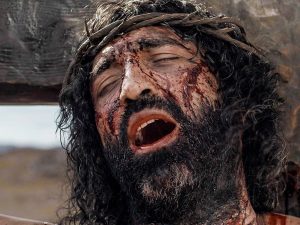
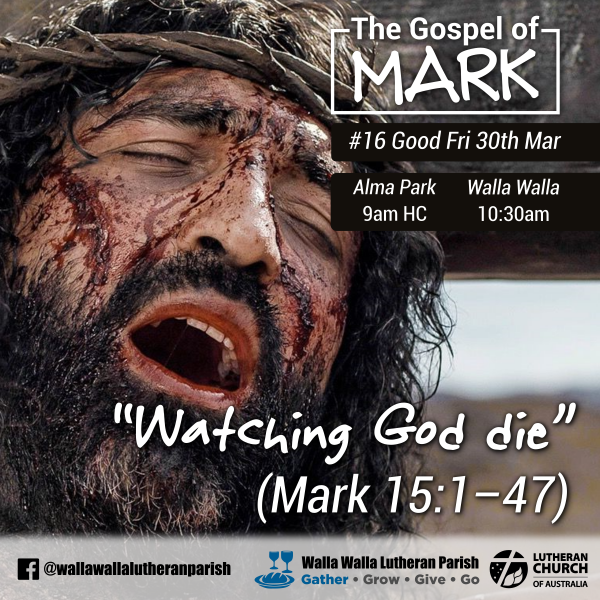
What do you see when you look at Jesus on the cross?
I think we mostly see a very sanitised version of events. We often see Jesus as a white Anglo-Saxon. He’s wearing a white cloth. There’s not too much blood. It’s all very dignified and reverent.
The cruel reality was that crucifixion was not just corporal punishment; it was a spectacle. It was designed to utterly humiliate and break the spirit of all who saw it. It was theatre sport used to deter others. And sadly, the Romans were experts at this ‘sport.’
Looking at Jesus with eyes wide shut
We heard in our reading that quite a few people watch Jesus die. And each has their own take on what they saw.
Firstly the soldiers look on. When they see Jesus they don’t see a powerful king, they see a weak man and a chance to abuse their power. They mock him, dress him in a purple robe, bash a crown of thorns deep into his head, and bow with false reverence. They strike, they spit. They parade him through the city and crucify him at a crossroad, to maximise the number of people who witnessed the spectacle, creating maximum fear in the occupied peoples. To finish his humiliation, they strip Jesus completely naked. Jesus’ clothes had once been transfigured into blazing white, whiter than any bleach on earth; but now they’re the spoils as the soldiers gamble.
Then there’s the two criminals crucified beside Jesus. They see a fellow political revolutionary, a rebel like them who tried to usurp the rulers, but seemingly failed. Even though they’re in the same boat, they hurl insults at Jesus — literally blaspheming, swearing at Jesus in God’s name.
The chief priests and teachers of the law also look on. They continue the mockery. “He saved others,” they said, “but he can’t [even] save himself! Let this Messiah, this ‘king’ of Israel, come down now from the cross, that we may see and believe.” (Mark 15:31–32). They say they want to see and believe, yet their eyes are shut to what’s really going on. They can only see a battered and bloodied body, arms outstretched, chest barely moving with laboured breathing. They see someone abandoned and tormented on a cross. “How could God have sent him,” they think?!
Looking at Jesus with eyes of faith
Jesus finally succumbs to death. A Roman centurion, who has been standing in front of Jesus, sees how he dies.
The others have judged the book by its cover. But this centurion sees something the others don’t see. With the eyes of faith, the centurion sees through the outward appearance to what really is.
Jesus smashes out of any neat little box we try to put him.
Jesus is a king. He is God clothed in royal robes of human flesh. He wears a crown, though made of thorns; his throne is a cross; attendants flank him on his left and right.
Jesus is a revolutionary. He’s come to transform the entire world, though not through sword or word. Rather he transforms the world through deed, through his own innocent suffering and death.
Jesus is the mighty Son of God. Except he refuses to use his power for himself, instead he dies a seemingly powerless death to save others — to save you and me.
Jesus is God’s love embodied. It may look like he’s held to the cross by nails, but it’s actually the love of God that keeps him there. Jesus willingly gives ‘his life as a ransom for many’ (Mark 10:45).
What do you see?
What do you see when you look upon Jesus dying on the cross?
Perhaps you’ve come here today to keep your parents or spouse happy, and you see a fairytale for the gullible. Maybe you see a gruesome death that happened long ago, with no relevance for your life today? Or perhaps you see nothing more than great teacher whose life was tragically cut short? Maybe you’ve seen this too many times and it’s commonplace now, the shame and scandal long worn off?
Whatever you see, this Easter let me encourage you to take another look at Jesus dying on the cross. Don’t judge this book by its cover; there’s more to Jesus than meets the eye. This man is a revolutionary king, the mighty Son of God, who embodies God’s love for you. He died to transform your life, because you are powerless to save yourself. His death is so powerful it even transforms the life of his executioner — the Roman centurion.
“One Solitary Life” by James Francis (1926)
He was born in an obscure village, the child of a peasant. He grew up in another village [not far away], where he worked in a carpenter shop until he was thirty. Then, for three years, he was an itinerant preacher.
He never wrote a book. He never held an office. He never had a family or owned a home. He didn’t go to [university]. He never lived in a big city. He never travelled [more than 300 kilometres] from the place where he was born. He did none of the things that usually accompany greatness. He had no credentials but himself.
He was only thirty-three when the tide of public opinion turned against him. His friends ran away. One of them denied him. He was turned over to his enemies and went through the mockery of a trial. He was nailed to a cross between two thieves. While he was dying, his executioners gambled for his garments, the only property he had on earth. When he was dead, he was laid in a borrowed grave, through the pity of a friend.
[Twenty] centuries have come and gone, and today he is the central figure of the human race. [It is safe to say] that all the armies that ever marched, all the navies that ever sailed, all the parliaments that ever sat, all the kings that ever reigned — [all of these] put together have not affected the life of [humankind] on this earth as much as [the] one, solitary life [of Jesus, the Christ].
(cited by Geisler and Turek, 2004, I Don’t Have Enough Faith to Be an Atheist, pg 324).
Blessing
As you look again this Easter, may the death and resurrection of Jesus transform your life today. May you see through the scandal of the cross and see how Jesus’ death fulfils Scripture. May you see Jesus’ end not as a tragic failure, but as a glorious fulfilment of God’s will: Jesus died to give his life as a payment to save yours. Amen.
[1] https://www.researchgate.net/publication/313878823_The_importance_of_first_impressions_in_a_job_interview