1. Markan triple cheese sandwich
Have any of you heard of a “Markan sandwich”? No, it’s not a sandwich made by Mark, or a sandwich with a mark on it! A “Markan sandwich” is a writing technique that Mark uses in his gospel. The particular events he records, and the way he writes them, are sometimes grouped together in a “sandwich:” two pieces of bread on the outside, with some filling on the inside. Mark uses this sandwich technique to help his hearers understand his story.
Our gospel reading today (Mark 10:46–52) is the last outside piece of bread in a triple cheese Markan sandwich.
I was teaching the confirmation disciples this week that Mark’s gospel can be divided into three acts:
- Act one, spanning chapters 1 to 8, is based in Galilee and swirls around the question “Who is this man?” as we see Jesus teach, heal, and perform miracles;
- Act two, which spans chapters 8 to 10, takes place while Jesus is travelling the road to Jerusalem and is actually one big Markan sandwich;
- Act three is Mark’s account of the passion in Jerusalem (Jesus’ suffering, death, and resurrection), taking up chapters 11 to 16.
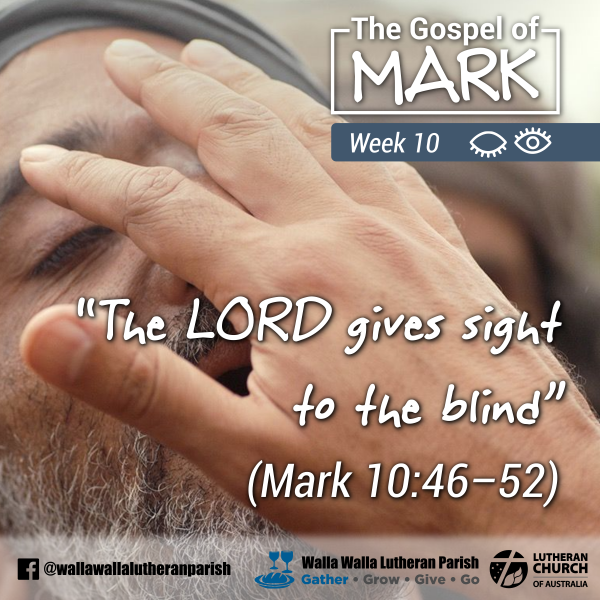
The first piece of bread in the sandwich is the healing of a blind man in Bethsaida in chapter 8 (Mark 8:22–26). The sandwich filling has three pieces of cheese. The same pattern is repeated three times: Jesus predicts his death, the disciples misunderstand, and Jesus teaches about discipleship. The final outside piece of bread is the healing of the blind man in Jericho — Bartimaeus.
Mark’s triple cheese sandwich means that this final healing is not just an amazing miracle, but a picture of discipleship that rounds off this entire part of his gospel. Mark is talking about more than physical sight — he is talking about spiritual blindness and discipleship.
So what does Bart’s story say about being a disciple of Jesus and following after him?
2. Bartimaeus is given sight
This last healing miracle in Mark takes place in Jericho. Jericho is about 25 kms north-west of Jerusalem. Pilgrims travelling to the temple would converge on this city, walking through the gates on their way to Jerusalem. This cross-road is a good place for a blind beggar to sit in the dirt on the roadside pleading for help and mercy. This beggar is very different to the rich man we heard about last week (Mark 10:17–31), who trusted in his wealth to make him right with God — these two are on the opposite ends of the social ladder.
Jesus passes through the city. There were lots of Jesus’ in ancient Palestine. Jesus was the sixth most popular Jewish name! But our beggar Bartimaeus hears that Jesus of Nazareth is passing by. Presumably he’s heard about this Jesus from other pilgrims walking through the city. So he begins to shout, “Jesus, Son of David, have mercy on me!” From what he’s heard, Bartimaeus thinks Jesus is the Messiah, the Son of David.
The crowd are embarrassed by this poor beggar yelling out. “Shhhh. Be quiet!” they say, trying to silence him.
But Jesus hears his plea and asks the crowd to call him over.
Bartimaeus jumps to his feet, eager to meet this Jesus of Nazareth, whom he confesses is the Messiah, the Christ. He even throws his cloak aside, leaving behind his meagre worldly possessions — very different from the earlier rich man.
Jesus asks him, “What do you want me to do for you?” It might seem like an obvious question, what do you expect a blind beggar to ask Jesus for? Yet Jesus has just experienced this triple cheese filling: the disciples three times misunderstand what kind of Christ he is. Jesus has come to suffer, be crucified, buried, and raised again for the forgiveness of sins. He is not an earthly king like David. In fact Jesus had asked this very question just a few verses earlier (Mark 10:35–45). James and John had come to Jesus with a mysterious request, “We want you to do for us whatever we ask.” “What do you want me to do for you?” Jesus asked them. In utter blindness they ask to sit on his right and left in glory. So we can understand why Jesus probes this blind man, asking this same question again, “What do you want me to do for you?” “What type of Christ do you think I am?”
The blind beggar gives a very different response to James and John. “I want to see,” he says. He wants more than physical sight, but also spiritual sight. Bartimaeus wants to see who Jesus really is.
The irony is that throughout this Markan sandwich those with physical sight are blind to who Jesus is. Yet this blind beggar sees the truth!
Bart is immediately healed. This word “healing” means more than just physical healing though. It means to be saved in body and soul. Bartimaeus is given the gift of salvation itself.
And his response? We’re told he follows Jesus along the way. And because of the sight that God has given him, he knows Jesus is on the way that leads to Jerusalem, to suffering and death.
3. So what?
Our Lord Jesus, the Son of David, has come to give sight to the blind. You were once blind. In your baptism Jesus touched and heal you. You were given his Holy Spirit which gave sight to your blind eyes, showing you who Jesus really is: the Son of David, the Son of Man, the Son of God, come in flesh to completely heal and save you in mind, body, soul, and spirit.
Just as Bart’s conversion from blindness to sight is a gift, God revealing himself to you is pure gift. Seeing Jesus for who he is is not something we can will ourselves. “The blind won’t see by opening their eyes.” We only see because the Son of David has had mercy on us. Like beggars we bring nothing but empty hands. Compare this with the rich man we heard about last week, who’s hands were full of earthly treasures in which he trusted more than Jesus. Instead Bartimaeus’ hands are empty, ready to receive healing and salvation.
And what a response when he’s called and healed! He leaps up, leaving his cloak behind, and follows after Jesus. How do we respond when Jesus heals our spiritual blindness? Do we eagerly leap up and leave behind our trust in worldly possessions, to follow Jesus to suffering and even death? What can we learn from how Bart responds?
In our confession of faith just before, we confessed all of this when we spoke these words:
I believe that I cannot by my own understanding or effort believe in Jesus Christ, my Lord, or come to him. But the Holy Spirit has called me through the gospel and enlightened me with his gifts.
“Enlightened” means to have the light turned on, for blind eyes to receive sight. I think this confession explains so much. No matter how hard we might try to tell others about Jesus, sometimes they just don’t get it. We might talk to we’re blue in the face, but family or friends don’t see why we believe in God, why we worship Jesus and come to church. “The blind won’t see by opening their eyes.”
Although we have been given sight when we received the Holy Spirit in our baptism, we still live in a dark world. There are still times when we don’t see, when we are spiritually blind to God’s Truth. That is why every time I preach or lead a Bible study, I pray for the Holy Spirit. I pray that God’s spirit may come to open our eyes to see him, God’s breath to open our ears to hear His Word. Every time you open your Bible at home, I encourage you to begin or continue this habit: pray for sight and enlightenment from the Holy Spirit to heal your blindness and save you through God’s Word.
Some of your friends and family may be living in dark caves. Some may not even realise they’re in darkness; they may not know what it means to have light to guide their lives. Some may be scared, or lost, fumbling about in the dark. We can not heal their blindness. Telling them to open their eyes is not enough. And they can’t will themselves to see either. “The blind won’t see by opening their eyes.” The gift of sight must come from Jesus and be received like a beggar with empty hands. But that doesn’t mean that we do nothing! We can pray for the Holy Spirit to heal their blindness. We can tell them about Jesus of Nazareth, so that when he comes by their gate, they too can call out, “Son of David, have mercy on me!”
Is there someone you know who is sitting in darkness? Lost, scared, fumbling in the dark? Picture them in your mind now. Let us pray for them.
Heavenly Father: we picture in our mind now a friend or family member who is living in blindness. Give us courage to tell them about your Son, Jesus of Nazareth. We ask that they may have an encounter with Jesus. May they kneel before him with empty hands and plead for his mercy, as we once did. Through your Son, give sight to their blind eyes. Cause them to see so that they too may follow after Jesus. Amen.