There was once a mighty warrior who led his army to many victories. One day a young squire was sent to his tent to help prepare the warrior for battle. As they were sharpening swords and readying horses, the squire asked his hero, “Why did you become a soldier?” The warrior looked down and answered, “I didn’t have the courage to be a farmer.”[1]
I’m a city boy through and through. Having come from the city two years ago, I’ve been learning a lot about farming. I’ve learnt that farming ain’t easy. It’s hard work. It takes courage to work the land year in and year out. Courage to persist in the face of changing weather, changing economy, changing tools and equipment.
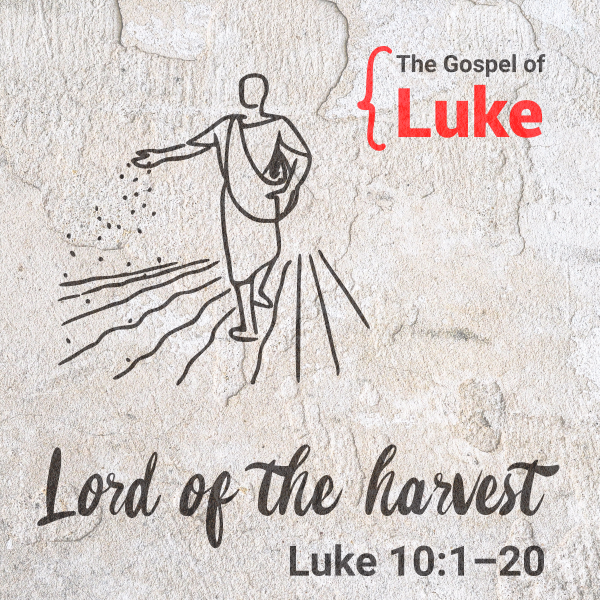
In our gospel reading (Luke 10:1–20), Jesus likens the mission of God to farming. He says, “The harvest is plentiful, but the workers are few. Ask the Lord of the harvest to send out workers into his harvest field.” (Luke 10:2). Jesus uses this metaphor of farming to help us understand his mission and our role in his mission. Working in the kingdom of God, spreading the good news of Jesus, is just like farming. What I’ve learnt about farming applies just as much to the kingdom of God.
(1) First, farming is hard work. There’s hours and hours of work involved, sometimes with very little result. Particularly up north at the moment, you sow a crop, hoping the rain will come, but it fails to show up and there’s no harvest. Or you sow, only for torrential rain to wash half of it away. It takes courage to pick up the pieces and try again, and again, and again.
Working in the kingdom of God is the same. It’s hard work and takes courage. Jesus says, “Go! I am sending you out like lambs among wolves.” (Luke 10:3). Sharing the gospel ain’t easy. Earlier in Luke chapter 8, Jesus tells a parable about a farmer sowing seed. Much of the seed this farmer sowed didn’t produce anything. Some fell on hard ground, some was eaten by birds, some strangled by the weeds. The seed is the Word of God. We work hard and sow and sow and sow, but the harvest doesn’t eventuate. The Word doesn’t penetrate hard hearts, the devil snatches others away, still others are seduce by the world. I know many of you have experienced this with family and friends.
But farmers have courage, perhaps more than great warriors. They have the tenacity to have yet another go. What do you do after a bad year? You try again. Eventually there will be a harvest. By using this farming picture, I think Jesus is encouraging us to keep on at it. Yes, spreading the gospel seed is hard. We’ll be like sheep among wolves. There will be failures. But we have a Good Shepherd guiding us. We have experienced God’s love for us through the death and resurrection of Jesus. What else can we do but keep on trying to tell others this good news?!
(2) Second, farming is all about the timing. I’ve been in this area two years now and I’m adjusting to the rhythms. The short winter days we have at present bring some rest as we wait for the warmth of spring to accelerate growth. But in comparison the seeding, harvest, and shearing times are frenetic. I’ve learnt that some activities are time bound and must be urgently attended to. “I’ve gotta get this spraying done before the rain comes.” “We need to harvest that last field of canola while we’ve got the truck.” “We need to get these lambs to market before the price drops.”
Timing is likewise important for the kingdom of God. There are certain rhythms and moments of great urgency. In terms of rhythms, we have our church year: Advent, Christmas, Lent, Easter, Pentecost, ordinary time. These rhythms bring different opportunities for us to keep on sowing the Word of God: community Christmas carols, Easter services.
Likewise, there is an urgency in God’s kingdom. Jesus says, “The harvest is plentiful, but the workers are few. Ask the Lord of the harvest to send out workers into his harvest field.” (Luke 10:2). In his day, harvesting was labour intensive. They needed extra labour during the harvest to gather the crop before it was too late. Our task of proclaiming that the kingdom of God has come near is also urgent. We don’t know when our time is up. We don’t know if this will be the last time we see a friend or family member. The time to gather the harvest is now. There is urgency in our mission. Jesus sent the seventy-two disciples off with specific instructions: “Do not take a purse or bag or sandals; do not greet anyone on the road” (Luke 10:4). He’s basically saying, “There’s not much time. Travel light. Don’t waste time socializing along the way. You need to go and get the job done now. Right now. Tell your friend what God is doing in your life today. Ask your mate this week if they’ve thought about what happens after death. Tomorrow tell your children that you pray for them to know God’s love.”
(3) Third, farming is full of the unexpected. I don’t think I’ve met a farmer yet who’s said to me, “Well, yesterday went exactly as I had planned!” More often I hear about setbacks and things going haywire, ad hoc on-the-fly solutions to problems. Jesus suggests that working in God’s kingdom is likewise full of setbacks and the unexpected. He anticipates we will be rejected and met with hostility. “When you enter a town and are not welcomed, go into its streets and say, ‘Even the dust of your town we wipe from our feet.’” (Luke 10:10–11).
The picture of God’s mission in this passage is totally unexpected. We hear nothing about one person being appointed as the minister. There’s nothing about training the workers. We might expect something about raising money or resources, but there’s no mention of this, in fact it’s commanded not to take any money or resources. We might expect the task of the workers is to convince people and bring them to a central location to hear the minister speak. What Jesus actually says is very unexpected. He appoints a sizable portion of the community. There’s not one or two individuals who feel called, but pretty much everyone is appointed to work in teams. They don’t gather in a central location, but are sent out into the world, to the surrounding houses and towns.
The method is also unexpected. Three things stand out: (i) the greeting of peace, (ii) the announcement of the kingdom of God, (iii) the practice of hospitality.[2]
(i) Jesus appoints us to bring peace everywhere we go. We’re called to bring peace into people’s homes and lives. We’re to say, “Peace to this house.” (Luke 10:5). This may sound simple, but the impact is huge. Think about how much unrest and conflict there is in the world: domestic violence, broken families, anxiety, stress, pain. The word ‘peace’ in the Gospel of Luke is just a synonym for ‘salvation,’ Remember when the angels announced the coming kingdom of God in the baby Jesus? “Glory to God in the highest heaven, and on earth peace.” (Luke 2:14). Peace comes to earth when we bring Jesus’ presence into hurting homes. If we think about how many hurting homes there are out there, no wonder the harvest is plentiful!
(ii) Jesus appoints us to announce the coming kingdom of God. “Tell them, ‘The kingdom of God has come near to you.’” (Luke 10:9). When we announce this, the kingdom of the devil is destroyed. I wonder what devils reside in this area? What dehumanises? What steals joy? What diseases are there? In contrast, the kingdom of God brings healing to the sick. The kingdom of God always serves those in need.
(iii) Jesus appoints us to practice and receive hospitality. Welcoming and accepting the stranger. Feeding the hungry. Clothing the naked. Visiting the sick and imprisoned. In hospitality we meet Christ himself (Matthew 25:31–36).
Peace, announcing the kingdom, hospitality — this is the unexpected missional call Jesus gives to each of us.
Ultimately we are farm hands, and God is the farmer. He is the Lord of the harvest, and we are his workers. As farm hands our job is to listen to the instructions and guidance of the farmer. So may you be given the courage to keep on doing the hard work of sowing the kingdom seed. May you work urgently. May you deal with the unexpected, as you speak peace, announce the kingdom, and practice hospitality. Amen.
[1] Based on a story told by Tim Brown, Acts 29 Rural Collective Summit 2019.
[2] Based on thoughts by Pastor Rick Strelan, ‘Breaking Open the Word.’