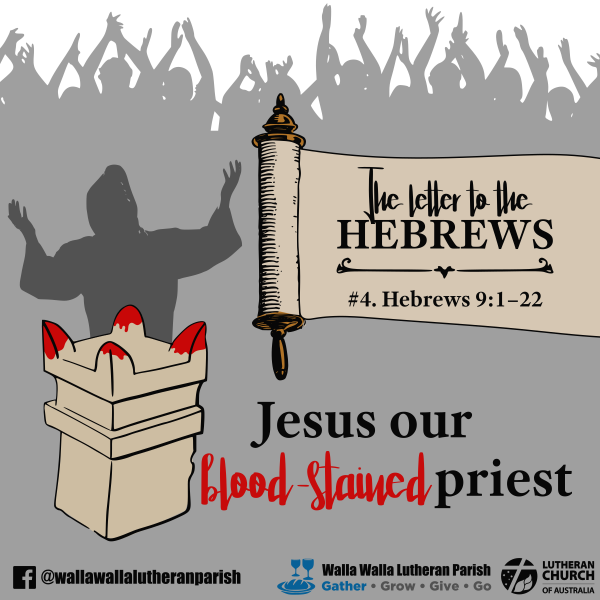
What’s with all the blood?
Blood is splattered all over the Bible. It’s painted on doorposts at Passover, Moses sprinkles it on the people, and it’s splashed against the altar in the tabernacle and temple. What’s with all the blood?!
In our culture blood is icky. Most of the time it’s related sickness e.g. you donate blood to help sick people in hospital. Blood is linked to sickness, death, and considered unclean.
Our cultural understanding of blood can make it hard for us to understand why there’s blood all over the Bible. In our reading from Hebrews, we hear about three uses of blood which are quite foreign to us.
(1) Blood can be exchanged for life
‘[Jesus] did not enter [the Most Holy Place] by means of the blood of goats and calves; but he entered the Most Holy Place once for all by his own blood, thus obtaining eternal redemption.’ (Hebrews 9:12).
For the Israelite people, blood was not primarily associated with death, but with life. In the Hebrew language “blood” is synonymous with “life.” They observed that once the blood had drained from an animal or person, all life was gone. Because of this association, blood from one animal or person could be exchanged for the life of another.
As strange as this may sound to our ears, it does have a kind of logic: if you’re thinking in terms of “eye for an eye, tooth for a tooth, life for a life” and if blood equals life, then you can exchange blood for life.
This idea probably makes as much sense to us as our monetary system would make to them. Imagine if we transported a Hebrew person forward to our time. They’d see us buying a lamb for $300 and say, “You’re exchanging one lamb for three small pieces of plastic — that doesn’t make sense.” Likewise, as we’re transported back to ancient Israel thousands of years ago and look at them splashing blood against the base of an altar we might say, “You’re exchanging the blood of an animal for the life of a worshipper — that doesn’t make sense.” But in their way of thinking it does make sense.
The preacher to the Hebrews says that Jesus exchanges his own blood for your life. This has obtained eternal redemption for you. Redemption means paying something, or exchanging something, for freedom. Jesus sets you free for all eternity by exchanging his blood for your life.
(2) Blood cleans
In our culture blood is seen as unclean. Take a look at the first few minutes of this video:
In contrast to this, in ancient Israel blood was seen as a cleansing agent, a bit like detergent. It could outwardly cleanse you, “sanctify” you, clean you up and make you holy so that you could appear in God’s presence. We use soap to scrub our hands and face before meeting the Queen; well they would use a blood ritual to make them outwardly clean before meeting God in the temple. (Aside: some blood was considered a source of contamination: blood from unjustified homicide and blood from a woman’s monthly cycle.)
The preacher to the Hebrews makes a distinction between the old blood cleansing rituals and the new cleansing obtained by the blood of Christ. He says that ‘the blood of goats and bulls … sprinkled on those who are ceremonially unclean sanctify them so that they are outwardly clean’ (Hebrews 9:13). The blood of animals only made the people ‘outwardly’ clean. But the blood of Jesus does so much more! ‘How much more, then, will the blood of Christ … cleanse our consciences from acts that lead to death!’ (Hebrews 9:14). The blood of Jesus cleanses more than the outside, he makes your ‘conscience clean.’
But what does this mean? Conscience is simply “seeing yourself as God sees you.” It’s that little voice telling you that you’ve done something wrong, something against God’s law. God doesn’t actually have to say anything because we know what he’s going to say. As we heard last week, God has written his law into our hearts and minds. When we break God’s law we know how he sees us — we have a bad or unclean conscience.
Let me explain with a story. As a child I made a large bonfire with my brother. It was dry, so our parents had said, “You can light the bonfire as long as you clear an area around it.” We didn’t clear any area. We were so excited that we just lit it. Soon after there was a small grass fire fanning out. We raced around stomping it with our shoes, using branches to snuff it out. I melted the soles of my favourite shoes, and there was so much smoke the local fire brigade sent a truck to investigate. Mum and Dad never said anything. They didn’t need to! I had melted shoes, a visit from the fire department, and a very guilty conscience. I could see myself through their eyes and I knew what they thought without them saying a word. This is what our conscience is: when we see ourselves as God sees us.
It’s all too easy to live our lives with a guilty conscience. But this robs us of the joyful service we can offer to God and each other. Do you have a guilty conscience at the moment from something you have done or left undone?
The preacher to the Hebrews has good news for you. Jesus is the unblemished Lamb of God, so his blood cleanses you better than the best detergent in the world. His blood cleans you on the inside and makes you a new person. It actually changes how God sees you! God looks inside you and sees a clean and holy person. Not because of anything you’ve done, but because the blood of Jesus has been sprinkled on you. Because God sees you as clean, your guilty conscience is taken away. Jesus wants to take away any guilt you harbour. All that’s needed is for you to realise how God actually sees you after you’ve been washed clean with the blood of Christ.
(3) Blood seals a covenant (legal agreement)
In ancient Hebrew culture, blood was used to seal a covenant between two parties. We see this in our Old Testament reading: ‘Moses then took the blood, sprinkled it on the people and said, “This is the blood of the covenant that the LORD has made with you.”’ (Exodus 24:8).
We can understand this use of blood a little easier. The preacher to the Hebrews uses a word picture we understand: he likens this situation to a legal will. For the legal agreement of a will to come into effect, there needs to be a death. The person who wrote the will needs to die. Blood needs to be spilled to “seal the deal.” In our culture we don’t sprinkle people with blood, but we understand that blood and death activate legal agreements.
By his death, by pouring out his blood, Christ is the mediator of a new covenant, a new agreement between God and his people. To show us how strong the agreement is, God “sealed the deal” with the blood of his only Son.
Jesus poured out his blood for you
All this talk about blood in the Bible is not just symbolic. The blood is real and accomplishes real things. Jesus gave his blood, and poured it out for you. Jesus exchanges his blood — his life — for yours. His blood cleanses you. It doesn’t just make you clean on the outside, but on the inside, changing the way God sees you, taking away your guilt. And through the blood of his Son, God binds himself to you in a legal agreement — the new covenant.
All of this comes together as we partake in Holy Communion. Jesus says that he offers you his blood as you drink the wine. In the Words of Institution we hear, “This is my blood of the new covenant, shed for you, for the forgiveness of sins.” May you live and serve God with a clean conscience as the blood of Christ cleanses you from all sin and is exchanged for your eternal redemption. Amen.