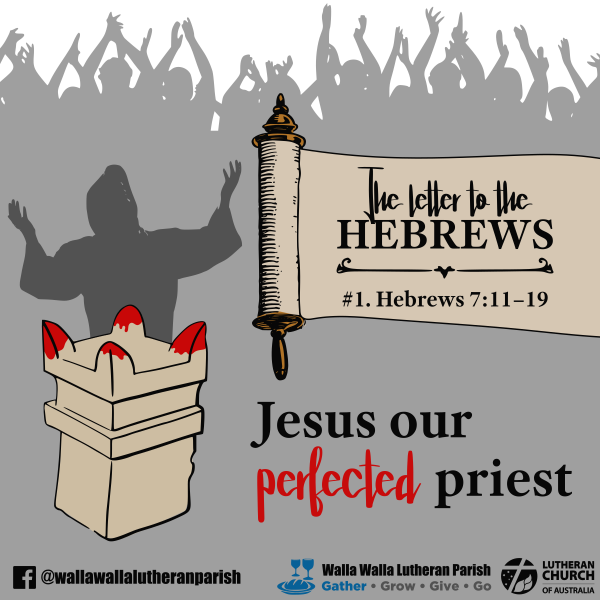
Is perfection possible?
What do you think of when you hear the word “perfect” or “perfection”? We most likely think of achieving excellence “your score was perfect,” “you performed to perfection”, “the dog showed perfect submission.”
The teacher in his letter to the Hebrews uses this word “perfection” in our reading. He says, ‘perfection cannot be attained through the Levitical priesthood’ (Hebrews 7:11), and ‘the Law made nothing perfect’ (Hebrews 7:19). He’s not talking about perfection as excellence, but “to bring to completion so the goal is reached.”
Let me explain it like this: Have you ever started a project but never completed it? I know a few people with cupboards or sheds full of unfinished craft works and projects. Is that you?! “Perfection” is when the project is finished and complete.
In our reading we hear perfection with God is possible — you can be finished and brought to completion. But perhaps not how we expect…
Two types of priests
In our reading we hear of two contrasting ways of being made perfect. These two different ways are represented by two types of priests: priests from the tribe of Levi established by the Law (“order of Aaron”), and the priest-king in the time of Abraham from the city of Salem (“order of Melchizedek”).
What’s a priest? A priest is a mediator between God and humans (one who stands between). Because God is holy, his people must be holy. Priests serve God by performing ritual actions to cleanse and purify the people, making them holy. Priests looked after the tabernacle (dismantling and moving the holy tent), and later served in the temple at Jerusalem. They prepared the offerings and cared for the sanctuary. Only priests could draw near to the sacred furniture & God’s presence in the Most Holy Place as they worked in the tabernacle/temple.
What’s the “order of Aaron”? At the foot of Mt Sinai in the episode of the golden calf, the tribe of Levi showed themselves to be loyal followers of Moses. So God said that priests would come exclusively from the family Aaron and tribe of Levi. God gave detailed commands (his “Law”) describing the role of priests, and their training (see the books of Exodus and Leviticus).
Priests in the order of Aaron were born into their role. Then they had a seven day apprenticeship — seven days of priestly training, after which they were “perfected” (some translations have “ordained”). Their training included (Leviticus 8:6–32):
- Being washed with water from the holy font.
- Being clothed with holy vestments and robes.
- Sacrificing flesh and blood as an offering (e.g. blood rubbed onto the altar horns, and blood sprinkled on the sides and poured out).
- Eating a holy meal consisting of a sacrificial ram and bread (the meat and bread would be eaten to complete the rite).
What’s the “order of Melchizedek”? Before the order of Aaron was established, we have this abrupt and short account of Melchizedek. We’re told he was the king of Salem (this city later became Jerusalem). But he was also a priest, ‘Melchizedek king of Salem brought out bread and wine, he was priest of God Most High.’ (Genesis 14:18).
The Law (“order of Aaron”) cannot make you perfect
The priests in the order of Aaron were the shadow of something to come. They’re a bit like an unfinished project: incomplete, not perfected.
The order of Aaron (given by the Law) is all about following rules step-by-step. “Do this, then do this, then it’s all good, you and God are okay.” But the problem is that the rules and steps don’t give you the strength to carry them out! So many times the people of Israel simply failed to follow the steps: they did one of the steps wrong, or ran out of puff and didn’t finish the project. Does this sound familiar?
Let me explain with a story: A man decided to build his own house using a kit. After ordering, the materials arrived and were dropped off at the site. He pulled out his 90-page instruction manual. The completed photo on the front cover looked amazing! So he eagerly got started. A contractor prepared the ground work and poured the slab. The man powered through the first 50 pages, assembling most of the frame by himself. But he slowly ran out of steam. And he couldn’t work out the diagrams about connecting the bracings for the frame. To this day the house sits unfinished, incomplete, & far from perfect.
The Law cannot bring anything to perfection. The commands are good, but they do not offer you any help to follow them.
Jesus has been made perfect
The teacher tells us the good news there is another way. ‘Jesus has become a high priest forever, in the order of Melchizedek.’ (Hebrews 6:20). Jesus is your priest, but not from the order of Aaron under the Law. Instead he has come to perform and complete the work God requires of you. He has been perfected and the work is finished. Like a priest, he has undergone and completed the ordination training, already been made perfect:
- Jesus was washed in the Jordon River in his baptism.
- Jesus has been clothed with glory (e.g. when he was transfigured).
- Jesus suffered and offered his body and blood as a sacrifice to purify his disciples; he sprinkles his blood to wash hearts clean.
- Jesus instituted a holy meal (Holy Communion) which gives his disciples strength and transforms their hearts to make them new people.
God is making you perfect
‘By one sacrifice [Jesus] has made perfect forever those who are being made holy.’ (Hebrews 10:14).
You are God’s work-in-progress, his unfinished project. If you strive yourself to finish (i.e. live under the Law) you won’t get there — it’s simply not possible. But Jesus is our perfected priest. He’s already finished God’s work. So he offers to bring you to completion, so that you can serve God along with him.
You are a priest in training. You’re in the midst of your “seven days” of on-the-job training as you are being “made perfect.”
- Your training begins with being washed in the waters of baptism.
- You are clothed with glory as Jesus gives you his righteous robes.
- You receive Jesus body as a sacrifice in your place, and your heart is sprinkled clean with Jesus’ blood (Hebrews 10:22).
- You share the holy meal which is a foretaste of the great heavenly banquet to come.
What does it mean day-to-day to be a priest-in-training?
- You’re invited to draw near to God and bring offerings as you a serve God here on earth — prayers, time, talents, possessions.
- Your work is holy — whatever you do as a priest-in-training is holy work for God (sweeping the floor, shovelling manure, paying taxes, etc).
- You’re invited to care for the temple — you are charged with caring for creation, working the ground, etc (the holy task given to Adam).
- You’re a work-in-progress — God is not finished with you, you still have more to learn, more ways to serve God here on earth.
- You’re training will end at your earthly death — upon death Jesus will finish you, making you perfect so that you can join the great heavenly banquet. There you will continue to serve God in his heavenly temple forever. In the meantime you serve here on earth, hoping and waiting to be brought to perfection. Amen.