I remember as a child looking forward to when I would be finished primary school — then things would be easier and I could stop learning! Then in the early years of high school I looked forward to university and working, when finally all this learning would be over. I eventually learnt that humans never stop learning. As long as we are living and breathing, we are learning. We learn something new almost every day, all the time. Our brains are changing and responding to what is happening around us. We are lifelong learners.
To prove the point, we’re going to learn something new right now. Here are few things you (hopefully) didn’t know before (from https://www.learnsomethingeveryday.co.uk):

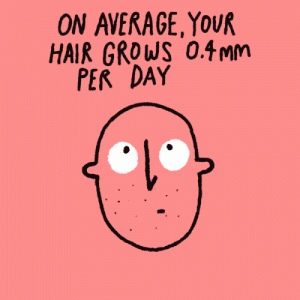
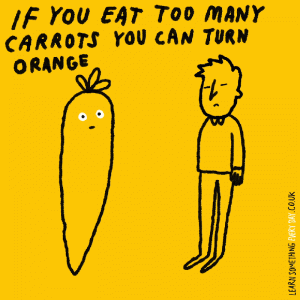
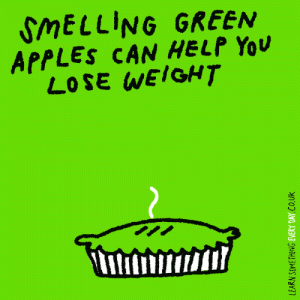
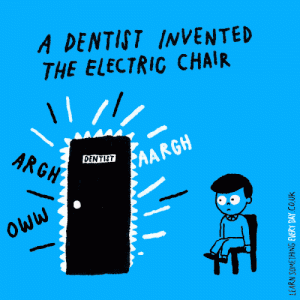
Humans never stop learning. As the old saying goes, “You learn something new every day.” We are lifelong learners.
Likewise, we are lifelong learners of Jesus Christ. In our gospel reading, Jesus calls his first disciples saying, “Come, follow me.” (Mark 1:17). Being a follower, or disciple, of Jesus means to learn from him. The word “disciple” can literally mean “learner” or “pupil” or “apprentice.” Think about this for a moment. You are a learner of Jesus Christ, his pupil and apprentice. A disciple is someone who sits at their master’s feet. They listen. They watch. They learn. They grow to trust their master.
Jesus has called you to be his disciple. He says, “Come, follow me.” Jesus calls you to sit at his feet. He calls you to listen, watch, learn, and be like Him. This learning is not something you do for a short season in your life. You don't get a graduation certificate (like when we're baptised or confirmed) that says you’re finished learning; rather, learning is never finished. Disciples of Jesus are lifelong learners.
We hear this lifelong learning aspect in our Old Testament psalm. This psalm speaks of three stages of life.
(1) ‘Since my youth, you God have taught me’ (Psalm 71:17). Our learning begins when we are young. The psalmist says that God taught him since his youth. This teaching happens in all sorts of different ways. We learn when we participate in worship as a baby, toddler, child, teenager, and young adult. We learn at Sunday school and Youth. We learn watching our parents pray. We learn when we talk with our grand-parents about their faith. It's important to recognise that young people learn differently than adults. They engage their imaginations. They are visual. They enjoy learning with their body (kinesthetic). Think back to how we’ve used our bodies in worship so far: we stood to recognise we are in the presence of the king, I used my hand to make the sign of the cross to remind us of our baptism, we sang praises and prayers with our mouths, we greeted each other as we passed God’s peace, we’ve been using our eyes to look at various pieces of art which symbolise God and his marvellous deeds, right now we’re using our ears to listen to the Word. And so on and so forth. All of this, whether we’re a child (or an adult), is teaching us the way of the LORD and His marvellous deeds.
(2) ‘To this day I declare your marvellous deeds’ (Psalm 71:17). Our learning has continued from our youth to this day, today. We can think back on all the life experiences we’ve had. Our present experiences are also ways that God teaches us. Schools sometimes talk about “the learning pit.” Learning can be like being thrown into a pit and having to work out how to get out. It can feel overwhelming to learn. God teaches us with this type of learning as well. Think about a tough circumstance or experience you’ve had in your life recently. An assignment or test that was hard. A plan that didn’t work out. Bad news that was unexpected. Each day you are in the learning pit of life. You may feel overwhelmed, asking, “Where’s God in this mess?” “Why is this happening?” Our psalmist experienced the learning pit also. They write a few verses later: ‘You have made me see troubles, many and bitter, [but] you will restore my life again; from the depths of the earth you will again bring me up.’ (Psalm 71:20). The promise of the gospel is that God knows you are in the learning pit. He’s with you in the depths of the earth. And he will bring you up. The reason we can trust and believe this promise is that Jesus has experienced the learning pit. He suffered. He died. He was buried in the pit — the tomb, the very depths of the earth. Yet the Father didn’t leave him there. Jesus was raised to life. God brought him up. And the good news and sure promise is that God will do the same for you.
(3) ‘Even when I am old and grey, do not abandon me, my God’ (Psalm 71:18). God is with you from the (baptism) font to the grave, from when you are young to this day until you are old and grey. And God is with you beyond the grave too. Because of Jesus’ death and resurrection, God promises not to abandon you. Instead He says, “You are mine,” “I love you,” “I am with you.” (One of the names of Jesus is Immanuel, “God with us”).
***
But how is faith formed? How do we learn from Jesus, our master? We believe God teaches us through the Holy Spirit. Yet the Spirit is uncontrollable. He is often pictured with violent or wild images e.g. loud wind or flames of fire. Jesus says, “The wind [or Spirit] blows wherever it pleases” (John 3:8). Yet, perhaps, we can cultivate opportunities for the Spirit to blow in our lives and our community. Here are three ways we can learn and know God: through the head, heart, and hands.
(1) Head (informed). We learn by the head — our faith is informed by understanding and knowledge. I think this is the most commonly recognised method of learning. Head knowledge. It’s about memorising, study, reflecting, articulating beliefs and doctrine. There’s heaps of different ways of doing this: reading and memorising Scripture, reading books that help you understand Scripture, learning and understanding the Catechism, podcasts & videos (checkout our website or Facebook for a list of online resources you may find helpful), Bible study groups, talking with other/mature Christians, listening to sermons (you're doing it right now), etc. God desires that we grow in knowledge so that we won’t be ‘blown here and there by every wind of teaching’ (Ephesians 4:14).
Now head knowledge is important, but it’s not the only way of learning and knowing God.
(2) Heart (formed). We learn by the heart — our faith is formed by dwelling in God's presence. If you hang out with someone long enough, they rub off on you. For example, children imitate and learn from their parents. I don't know how many times I've been watching my kids and, for better or for worse, seen or heard something that I've said or done. Just the other night I was clearing the table and dropped some dirty cutlery. I was frustrated with myself and let out a loud groan. And the kids said, “It's alright, Dad. It's just a mistake. We can clean it up.” I could hear myself in their reaction. It’s the same with God, our Father. If you hang out with him long enough, he starts to rub off. His words become your words. His thoughts become your thoughts. His ways becomes your ways. Your heart is formed by being in God's presence. Our ‘heart’ is the organ of desire and will. So when our heart is formed by God, our desires and actions are formed to be like him. Again, there’s many different ways of learning by the heart: we’ve already heard that God teaches our heart through experience; music is another way, often called “the language of the heart” (you could try singing hymns, listening to good contemporary Christian music, watch YouTube music videos, etc); meditate on a Scripture passage (meditate means to chew over it, speak it slowly, repetitively); sit in God’s creation; celebrate Holy Communion; etc. All of these are encounters with God’s Word and Spirit (his presence) that form who you are, and form your heart.
(3) Hands (transform). We learn by the hands — our faith is transformed as we show love, serve, and make peace in the world with our hands. Being a disciple/learner means we are Jesus’ apprentice. An apprentice gets their hands dirty, they learn by doing. We’re actually going to unpack this topic of ‘Acts of service’ more next week.
***
We grow in faith as God teaches us through our head, heart, and hands. As a disciple of Jesus, as a lifelong learner, how are you learning from your master?
Here’s a challenge for you this week: Think about the most important thing you have learnt about God these past 12 months. Share this with someone, and ask them to share what God has taught them this year.
Let us continue to learn and declare God’s marvellous deeds when we are young, this day, and when we are old and grey. Amen.