Recently there was a show aired on the ABC called ‘Old people’s home for 4 year olds.’ The show was based on the premise that it is beneficial for everyone (older persons and young kids) to have interaction with different generations. Pre-schoolers attended classes at an aged care facility. They did some baseline testing for each older person (mental health, physical health, etc) before the experiment, then they had six weeks with the kids, then performed the same experiments. They results were conclusive — it is beneficial for older persons to spend time with young children.
Just as inter-generational interaction is beneficial for health and well-being, it's good for spiritual well-being and the church. In fact, God has designed church to be inter-generational.
Psalm 145 is a song of praise ascribed to King David. He sings, ‘One generation commends the works of the LORD to another’ (Psalm 145:4). God has created you to age and experience different stages of life. Yet whatever stage of life you are, God brings us together as one body, so that one generation can commend God’s mighty works to another. God has designed church to be inter-generational.
1. God has created you to age and experience different stages of life. One can picture life as a circle. In fact, the Hebrew word for “generation” is derived from their word for “circle.” We are all born, live and move through various stages of life (child, teenager, young adult, mature adult, aging adult), and then we all die. The circle of life spans from birth to death. Each generation produces children, spawning a new set of circles.
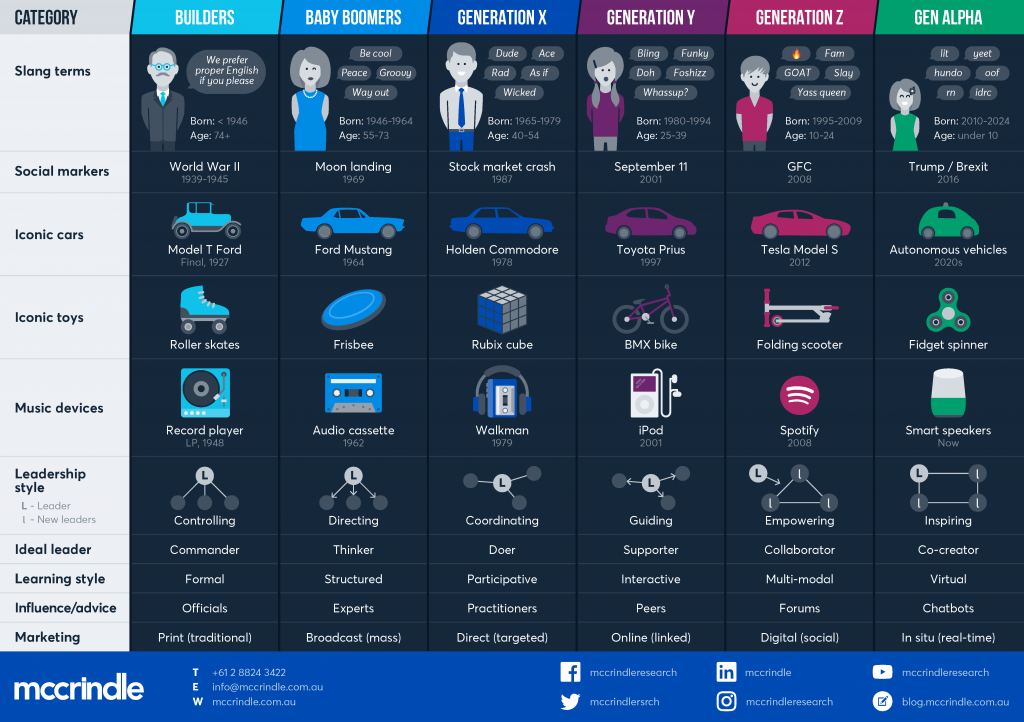
Each person is at a different stage of this life circle. Each generation is different, with different needs and desires. Just to give us a quick glimpse at some of these differences, here is an infographic from a group called McCrindle Research.
2. Each generation interacts with the others. God created us to interact with people from various generations. Our psalmist says, ‘Generation to generation they shall commend your works.’ Most commonly we might think of the older generation passing their ‘wisdom’ onto the younger generation. And, yes, this is true. You might say this is what St Paul is talking about in his letter the church in Corinth. ‘For I received from the Lord what I also passed on to you’ (1 Corinthians 11:23). St Paul has been given the sacrament of Holy Communion, he then passes this onto the younger church in Corinth. This could be pictured as a baton relay. However I’m not sure this is the best picture — it’s very one directional.
Notice that when our psalmist says ‘generation to generation,’ he doesn’t rule out the other direction — the younger generation passing something onto the older. Take for example our gospel reading: Jesus places a child in the midst of his congregation, and the older listeners learn from the child. Jesus says, ‘Unless you change and become like little children, you will never enter the kingdom of heaven’ (Matthew 18:3). Perhaps a better picture than a baton relay is a pond: each generation is a stone or rain drop that produces a ripple, the ripples (or circles) propagate outward, interacting and influencing each other.
3. Each generation is to tell the other the works of God.
One generation commends your works to another; they tell of your mighty acts. They speak of the glorious splendour of your majesty — I will meditate on your wonderful works. They tell of the power of your awesome works — and I will proclaim your great deeds. (Psalm 145:4–6).
The psalm says again and again that we are commend, tell, speak, meditate, proclaim the words of God. But what are these works? How would you summarise the entire story of God? Mission scholar Christopher Wright uses one approach when he speaks about ‘the whole story of the Bible on the back of an envelope’ using six parts.
Today is Reformation Sunday. We remember and celebrate Martin Luther and the other reformers, who recovered for us the gospel. The Roman church in the 1500's was caught up in the law. The church taught that to be a Christian meant to follow the law: “do this, do this, do this, and then you’ll be a Christian.” “Pay this money to be forgiven. Say this prayer to be saved. Watch the priest perform this ritual to receive a blessing. Etc.” But the Reformation recovered for our generations today the gospel of Jesus Christ. It is Jesus Christ alone who ‘rescued me when I was lost and sentenced to death.’ And now this good news has been passed onto our forebears, who brought it to Australia, who have commended the works of the LORD from generation to generation until today. Now it is your turn to commend the works of the LORD to future generations.
4. How do we commend God’s work to others? This is hard! It means thinking about the other generations, trying to understand where they are coming from. It means loving others, putting the needs of other generations before your own. It means listening. It means giving up something you might appreciate in order to love someone else. For example: typically, though not always, different generations appreciate different styles of music or worship. So it might mean, from time to time, enjoying other styles of music and worship than what you prefer. And this goes both ways!
Here are some practical resources sheets for living together as an inter-generational church. Please have a good read of these. They are full of helpful, practical ideas to commend the works of the LORD to another generation. Choose one idea and try it!
As we journey together, I think we will come to realise that each generation has someone wonderful and special to give to the others. Let me close with a story illustrating this point.
The Little Boy and the Old Man (by Shel Silverstein) [A little boy and an old man were sitting together, talking.] Said the little boy, “Sometimes I drop my spoon.” Said the old man, “I do that too.” The little boy whispered, “I wet my pants.” “I do that too,” laughed the old man. Said the little boy, “I often cry.” The old man nodded, “So do I.” “But worst of all,” said the boy, “it seems Grown-ups don’t pay attention to me.” And he felt the warmth of a wrinkled old hand. “I know what you mean,” said the old man.
God has designed church to be inter-generational. We are called to tell out our soul from generation to generation. This includes younger generations receiving the baton passed on by older generations. But it also means the older generations receiving from the younger ones. Let us feel the love and warmth of each other’s hands as we hold each other and walk together, one generation commending the works of the LORD to another. Amen.