Lightning fast
The other week I was watching a lightning storm with my daughter. It was a frustrating experience. I would see a flash of fork lightning. “Look over there,” I’d say, pointing. Inevitably by the time she looked, the lightning was gone. The flash of brilliance dissipated.
The glory of Jesus dissipates as fast as lightning
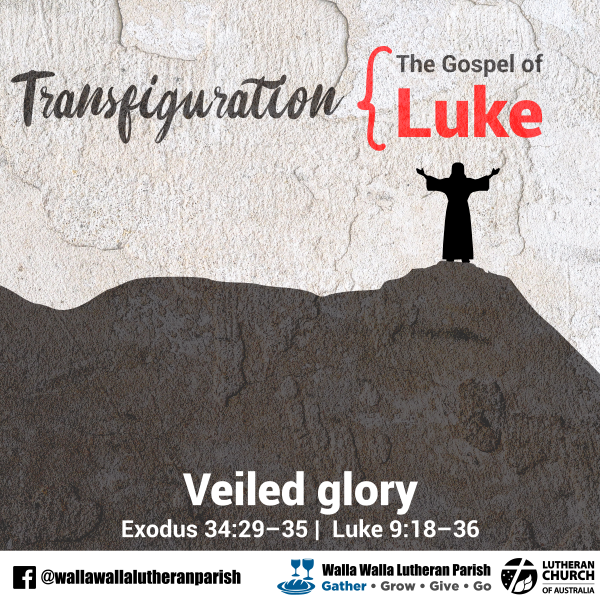
I think the transfiguration story in our gospel reading is a bit like my experience looking at lightning with my daughter. Jesus’ glory is revealed then gone, like a flash of lightning.
Luke chapter 9 has a question hanging in the air: “Who is Jesus?” At the start of the chapter, King Herod asks about Jesus, “Who is this I hear such things about?” (Luke 9:9). Jesus asks his disciples, “Who do the crowds say that I am?” (Luke 9:18). Lastly Jesus asks his disciples point blank, “Who do you say that I am?” (Luke 9:20).
Then, in a flash of lightning, Peter, James, & John get to see who Jesus really is. His humanity is stripped away and they briefly glimpse the brilliant divine nature of God in Jesus. We’re told his face changed and his clothes became as bright as a flash of lightning.
Yet, like lightning, the glory quickly dissipates. The experience slips away. Peter tries to prolong it, by suggesting they build tents. But a cloud envelopes them, and they can no longer see. They hear the voice of God, “This is my son, whom I have chosen; listen to him.” (Luke 9:35). Then before they know it, they’re walking down the mountain, back to reality.
I’ve always wondered what these three disciples were thinking as they walked down the mountain: “If only we could have brought the rest of the twelve up here! If only everyone could see this, then they would believe that Jesus is God. But who will believe us now…?”
Some of us here might have had a mountain top experience with God. Perhaps we’ve seen or felt God’s presence in an amazing and tangible way. “If only others could see what I’ve seen or have the same experience, then they too would believe,” you might have thought. “If only God would reveal his glory, then my spouse/children/grand-children would believe that Jesus is God.”
Or maybe you haven’t had an experience like this. Perhaps someone keeps pointing where to look, but by the time you do it’s gone. You look for God’s glory but can’t find it, and begin to question if it’s just a make-believe myth. “If only someone could show me some hard evidence! If I could just see Jesus in all his glory, then I’d believe.”
Unfortunately the transfiguration of Jesus is over like a flash of lightning. And we’re left with a bunch of questions: “Why doesn’t God reveal his glory so that everyone can believe in him? Wouldn’t it be easier to confess our belief in God if we could see him and point him out to others?” These are tough, but important, questions.
Veiled glory
I think our Old Testament reading can shed some light on this dilemma.[1] ‘When Aaron and all the Israelites saw Moses, his face was radiant, and they were afraid to come near him’ (Exodus 34:30). God’s glory, shining in all its fullness, is frightening. The people were frightened even of God’s reflected glory in Moses’ face. Luke tells us the disciples were afraid as they beheld God’s glory on the mountain (I think that’s why the cloud enveloped them — to shield them from God’s glory).
Instead of overwhelming us with radiance, God has chosen to veil himself. Looking directly at a bright light hurts. But if the light is veiled, then we can safely look. Likewise, God has lovingly veiled his glory.
Where can we see the veiled glory of God?
Now this doesn’t mean that we can’t see God. In fact Jesus himself says, “Truly I tell you, some who are standing here will not taste death before they see the kingdom of God.” (Luke 9:27). We can still see God and his kingdom, it’s just that he’s veiled. We must look with the eyes of faith. So where can we see the veiled glory of God?
(1) God is veiled in creation. I’ve often seen God’s veiled glory in creation and nature. A sunset. Surveying the landscape after hiking a mountain. Sitting on the beach watching and listening to the waves. Gazing up at the stars. Perhaps you’ve had the same experience? St Paul writes, ‘For since the creation of the world God’s invisible qualities — his eternal power and divine nature — have been clearly seen, being understood from what has been made’ (Romans 1:20). The beauty and order we see in creation point to a master artist who has carefully crafted our universe. Yet we don’t see God himself, just his brush strokes, his veiled glory. One example is the so-called “fine-tuning” problem. Carbon-based life on earth depends on a delicate balance of natural fundamental constants — like the speed of light, the gravitational constant, and the masses of the elementary particles. There’s at least six of these numbers that are perfectly balanced to allow life, the universe, and everything to exist. If any of these numbers were slightly altered, the balance would be destroyed, and we wouldn’t exist.[2] Other worldviews struggle to explain this fine-tuning. Yet it fits perfectly with Christian beliefs. It doesn’t prove God’s existence, but it is one example of where God’s veiled glory is visible to us.
(2) God is veiled in Scripture. On the surface, the Bible looks like any other book: it has front and back covers, pages, chapters, sentences, words, letters. But veiled behind the words is the glory and power of God. St Paul says, ‘The message of the cross looks like foolishness to those who are dying, but to those being saved it is the power of God!’ (1 Corinthians 1:18). It is in Scripture that we see the glory of God revealed in Jesus e.g. the transfiguration account. We don’t see his full glory, but it’s behind the words and letters. Through faith, we rely on God to open our eyes & ears to see & hear him as we read the Bible.
(3) God is veiled in the sacraments. In baptism, God’s saving work is veiled in water. In Holy Communion, the body and blood of Jesus is veiled in bread and wine. We see the ordinary, earthly things — like water splashed on a baby, and people eating and drinking bread and wine — but underneath and behind these is God himself. Martin Luther tried to explain God’s veiled glory in Holy Communion by saying Jesus’ presence is “in/with/under” the bread and wine (Small Catechism).
(4) God is veiled in Jesus on the cross. Of course the ultimate place we see God’s veiled glory is in Jesus himself. God the Creator willingly took on human flesh to become one of his creatures. God suffered, was humiliated, tortured on the cross, and died for your sake in the person of Jesus.
Let me close with a story. You might have heard this before, but it beautifully illustrates God’s veiled glory in Jesus. It’s called “The King and the Maiden” by Søren Kierkegaard:
Suppose there was a king who loved a humble maiden. The king was like no other king. Every statesman trembled before his power. No one dared breathe a word against him, for he had the strength to crush all opponents. And yet this mighty king was melted by love for a humble maiden who lived in a poor village in his kingdom. How could he declare his love for her? In an odd sort of way, his kingliness tied his hands.
If he brought her to the palace and crowned her head with jewels and clothed her body in royal robes, she would surely not resist — no one dared resist him. But would she love him? She would say she loved him, of course, but would she truly? Or would she live with him in fear, nursing a private grief for the life she had left behind? Would she be happy at his side? How could he know for sure?
If he rode to her forest cottage in his royal carriage, with an armed escort waving bright banners, that too would overwhelm her. He did not want a cringing subject. He wanted a lover, an equal. He wanted her to forget that he was a king and she a humble maiden and to let shared love cross the gulf between them. For it is only in love that the unequal can be made equal.
The king, convinced he could not elevate the maiden without crushing her freedom, resolved to descend to her. Clothed as a beggar, he approached her cottage with a worn cloak fluttering loose about him. This was not just a disguise — the king took on a totally new identity — He had renounced his throne to declare his love and to win hers.
Jesus is the king who has willingly veiled his glory to win your love. May you be given the eyes of faith to see the veiled glory of our God. Amen.
[1] Pun intended!
[2] Alister E. McGrath, 2012, Mere apologetics: How to help seekers and skeptics find faith, Baker Books.