This Lent we’re using our whole bodies, including our imagination, to help us meditate on Christ’s suffering for us. Our meditation today is based on a story in the Gospel according to Luke, where Jesus’ feet are anointed with tears and perfume oil. Our meditation today will focus on feet. I invite you to relax your body. You might like to sit with your arms on your lap. If you wish, at times you may even like to close your eyes.
When one of the Pharisees invited Jesus to have dinner with him, he went to the Pharisee’s house and reclined at the table. A woman in that town who lived a sinful life learned that Jesus was eating at the Pharisee’s house, so she came there with an alabaster jar of perfume. As she stood behind him at his feet weeping, she began to wet his feet with her tears. Then she wiped them with her hair, kissed them and poured perfume on them.
Think about your feet. Wriggle your toes to feel them. From the beginning of your day, think about where your feet have been. What surfaces have your feet been standing on — bed, carpet, tiles, grass, inside socks? What sensations have your feet experienced — cold, wet, pain, itchy? Where have your feet taken you — bedroom, kitchen, bathroom, shower, sidewalk, car, work, church building? Try to recall every room and place your feet have taken you so far today. Picture whom your feet have allowed you to serve.
Feet were very important in Jesus’ day. Most people walked where they needed to go. They wore sandals and ended up with dusty, dirty feet. Washing the feet of a guest was a way to show hospitality, perhaps like offering an overnight guest a warm shower.
Think about Jesus’ feet. Where have they been so far? A stable with hay; the stone floor of the temple; the waters of the Jordan; the dry and parched wilderness; his synagogue at home in Nazareth; the sands of the Sea of Galilee; walking through grain fields.
When the Pharisee who had invited him saw this, he said to himself, “If this man were a prophet, he would know who is touching him and what kind of woman she is — that she is ‘a sinner.’ ”
The Pharisee sees what unfolds. And what he sees is — to him — very controversial: a woman who is ‘a sinner’ (a label used for outcasts) touches Jesus’ feet thereby contaminating him with her supposed uncleanliness. Simon sees ‘inappropriate behaviour by the standards of that time. The woman comes into the midst of a dinner reserved for men, carries a bottle of perfume, unlooses her hair (a particularly erotic action for Jewish perceptions), repeatedly kisses Jesus’ feet, and finally in the presence of all the guests does something that belongs in the realm of intimate behaviour or even of perverse practices: she anoints his feet.’[1] Have you recently judged someone by what you saw? Do you judge yourself by what you see or perceive? Jesus judges people very differently than our Pharisaical nature. Listen to how he judges this woman — what does he see?
Jesus answered him, “Simon, I have something to tell you.” “Tell me, teacher,” he said. “Two people owed money to a certain moneylender. One owed him five hundred denarii, and the other fifty. Neither of them had the money to pay him back, so he forgave the debts of both. Now which of them will love him more?” Simon replied, “I suppose the one who had the bigger debt forgiven.” “You have judged correctly,” Jesus said. Then he turned toward the woman and said to Simon, “Do you see this woman? I came into your house. You did not give me any water for my feet, but she wet my feet with her tears and wiped them with her hair. You did not give me a kiss, but this woman, from the time I entered, has not stopped kissing my feet. You did not put oil on my head, but she has poured perfume on my feet. Therefore, I tell you, her many sins have been forgiven — as her great love has shown. But whoever has been forgiven little loves little.”
Simon the Pharisee sees a sinner acting in an inappropriate way. But Jesus sees something else entirely. He tells a story to show what he sees: he sees a child of God who has been forgiven much, so loves much. Simon is so concerned with this woman’s behaviour that he has not paid any attention to his own. Three times Jesus uses the following formula: “you …, but she …” “You did not give me any water for my feet, but she wet my feet with her tears. You did not give me a kiss, but she has not stopped kissing my feet. You did not put oil on my head, but she has poured perfume on my feet.” What Jesus sees is Simon’s lack of hospitality! In contrast, in this woman Jesus sees one who has been forgiven much and so loves much. She loves without abandon. Her love is risky and reckless. She breaks all the rules. She doesn’t care what others think of her as she demonstrates her love in response to God’s mercy. What can we learn from this woman? Are we too concerned with what others think? How can we show risky and reckless love?
Then Jesus said to her, “Your sins are forgiven.” The other guests began to say among themselves, “Who is this who even forgives sins?” Jesus said to the woman, “Your faith has saved you; go in peace.”
Jesus tells the woman to “go in peace.” Her feet walk out of that house forgiven, in peace.
Think again about Jesus’ feet. Where are his feet about to go? They will soon climb a mountain to be transfigured; walk along the road to Jerusalem; kneel in prayer; rub against a donkey riding into the city of David; once again stand in the temple; sit around a table with his disciples; kneel on the Mount of Olives; travel, perhaps in chains, to the house of the High Priest; stand before the Sanhedrin council and in the palace of the Pilate the Roman Governor; walk toward the place of the Skull; be pierced with nails and buried in a tomb.
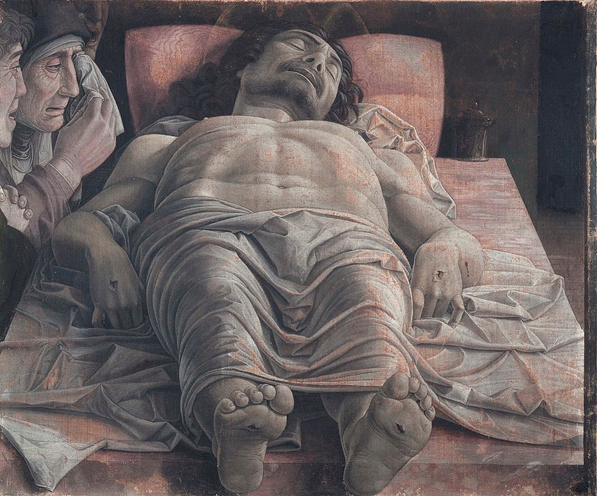
Take some time to study the painting ‘The Lamentation of Christ’ by Andrea Mantegna (1480), particularly notice Jesus’ feet. [2] These wounded feet are the very same feet that the woman anointed with perfume oil and wash clean with her tears. To her these wounded feet are beautiful. As the prophet Isaiah writes: ‘How beautiful on the mountains are the feet of those who bring good news, who proclaim peace.”’ (Isaiah 52:7).’
Think about your feet again. Wriggle your toes. As disciples, your feet are called to follow Jesus. They too will be wounded at times. Blistered from hard work. Sore from walking across rocky ground. But God looks at you differently than you see yourself. He sees a forgiven child of God. He sees beautiful feet. As your feet carry you about, you too bring the good news of Jesus and proclaim God’s peace. As a sign that your feet are beautiful, let’s anoint them with perfume.
We pray. Heavenly Father: thank you for sending Jesus to walk this earth among us, as one of us. His feet have been pierced and wounded to bring us healing and peace. Help us to see those to whom our feet take us as your children. Help us to show risky and reckless love without concern. Make our feet beautiful as they carry your good news and peace to the world. Amen.
[1] François Bovon, 2002, A Commentary on the Gospel of Luke 1:1–9:50, page 295.
[2] ‘In Roman times … the rule [was] to nail the victim by both hands and feet. … Binding the victim to the cross only with bonds remained the exception.’ Martin Hengel, 1977, Crucifixion: In the Ancient World and the Folly of the Message of the Cross, pages 31–32.