A kiss
Think about the last kiss you gave? It might have been to your spouse as a sign of affection. Perhaps you kissed your grandchild hello when you last saw them. Perhaps you greeted a friend and kissed them on both cheeks (our Assyrian visitors did this a few weeks ago). It’s not so common these days, but sometimes we kiss the hand or ring of a superior to show our loyalty or obedience. For example, Jewish students would often kiss their rabbi in this way.
In our gospel reading Judas attempts to kiss Jesus. On the outside it looks like a kiss: a sign of affection between two friends, a greeting, a sign of loyalty between student and master. Yet underneath this is betrayal. Judas means it as a sign to indicate to the guards which person they should arrest. This kiss is a friend betraying a friend. A slap in the face. A student turning on his master. As we heard on Ash Wednesday, the devil has entered Judas, possessing him and using him for his satanic purposes (Luke 22:3).
Jesus, who has been deep in prayer just moments before, wrestled with the will of God. He knows what’s underneath this kiss. “Judas, are you betraying (handing over) the Son of Man with a kiss?” (Luke 22:48). Jesus has known his path for some time. Just after his transfiguration, as he’s setting out on the road to Jerusalem, ‘Jesus said to his disciples, “Listen carefully to what I am about to tell you: The Son of Man is going to be delivered (handed over) into the hands of men.” But they did not understand what this meant. It was hidden from them, so that they did not grasp it.” (Luke 9:43–45).
And just a few hours before the events in the garden, Jesus shared the Last Supper with his disciples. ‘After the supper he took the cup, saying, “This cup is the new covenant in my blood, which is poured out for you. But here at this table, sitting among us as a friend, is the man who will betray me. For it has been determined that the Son of Man must die. But what sorrow awaits the one who betrays him.”’ (Luke 22:20–22).
And so the hour has come, darkness has descended. The Son of Man is handed over, and darkness reigns.
The darkness
“Every day I was with you in the temple courts, and you did not lay a hand on me. But this is your hour — when darkness reigns.” (Luke 22:53).
What is Jesus referring to when he says “darkness reigns”? I think the darkness here has many levels. Of course it’s night time in the garden, but Jesus means much more than this. The next day, as Jesus will hang on the cross, darkness will descend as Jesus is crucified, but again there are still more levels. ‘Darkness’ often referred to the rule of Satan and evil forces, the brokenness of creation. ‘Darkness’ was also a sign of the times before the end of the world, before the light of dawn of eternal life. I think all of these meanings are at play: darkness at Jesus’ crucifixion, darkness of evil, darkness before the light of new life.
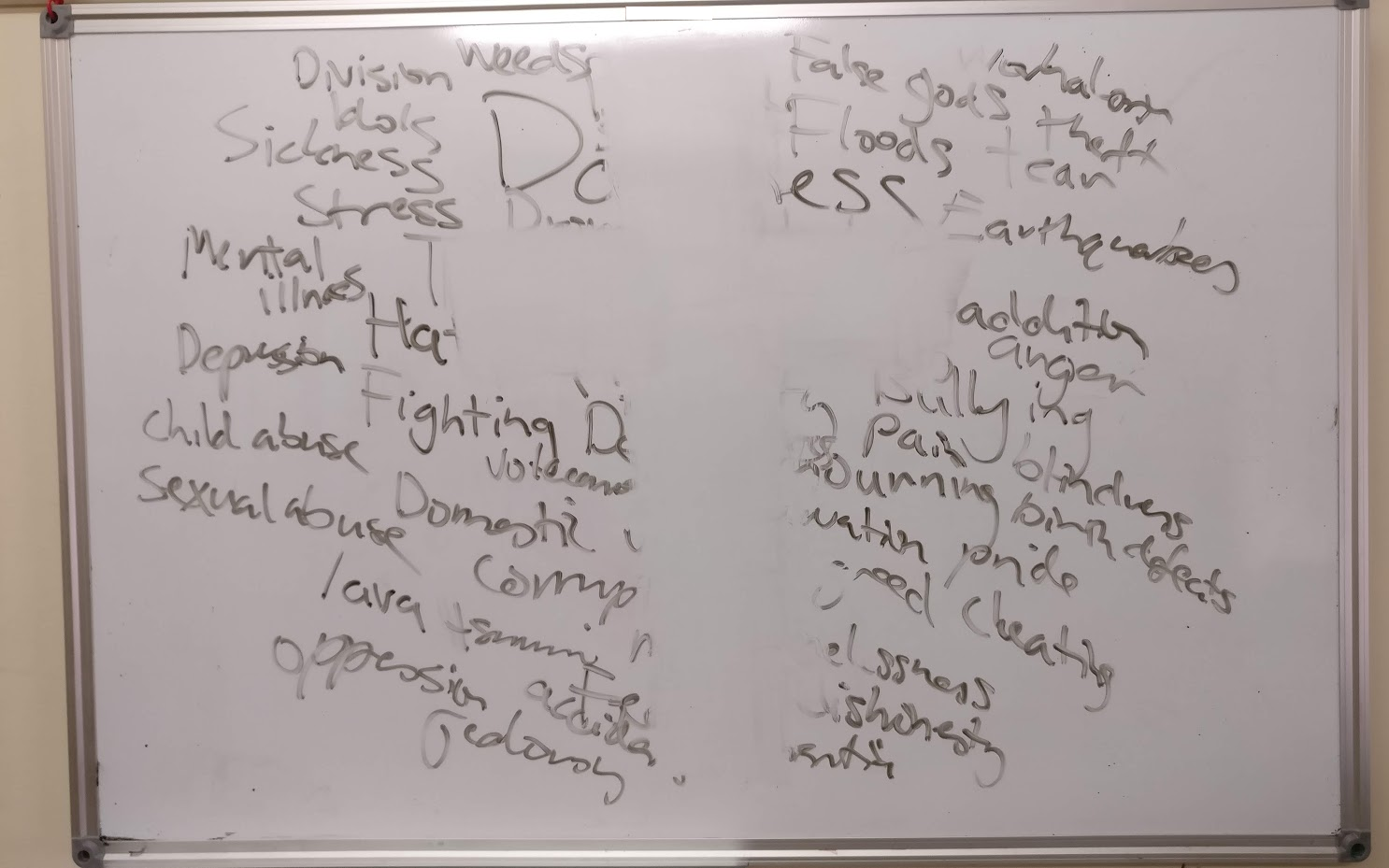
Can you think of some examples of the darkness that reigns in our world? Try to be fairly specific. Think about dark things that have touched your life and family. Call out examples of the darkness you see and experience, and I’ll write them on a whiteboard. Some examples may include: death, murder, hurt, hatred, divisions, wars, fighting, dissention, torture, terror attacks, tears, fear, mourning, betrayal, pain, slander, fits of rage, gossip, envy, pride, gluttony, selfishness, idolatry, witchcraft, satanic arts, blasphemy, workaholism, theft, lust, coveting, jealousy, orgies, love of money, cheating, hopelessness drunkenness, substance abuse, poverty, oppression, starvation, sexual abuse, physical abuse, disease, cancer, sickness, miscarriage, genetic disorders, mental illness, fire, floods, famine, drought, earthquakes, weeds, decay, broken families, separation, infidelity, birth abnormalities, genetic disorders, abortion.
A rebellion
“Am I leading a rebellion, that you have come with swords and clubs?” (Luke 22:52). Jesus asks, “Am I a rebel? Am I a freedom fighter?” Interesting that Jesus doesn’t answer his question!
Is Jesus leading a rebellion? No, not a rebellion with swords and clubs. Around Jesus’ time there were a group of Jews who thought they could bring about God’s kingdom by force, with swords and clubs. They were called ‘Zealots,’ political rebels and freedom fighters. Simon Peter takes his sword and strikes off the ear of the guard, but Jesus squashes this form of rebellion. Jesus is not a Zealot seeking to bring about God’s kingdom by force. It’s ironic that he will be crucified between two rebels.
Is Jesus leading a rebellion? Yes, a non-violent, peaceful rebellion against darkness. Jesus says, “I am the light of the world. Whoever follows me will never walk in darkness, but will have the light of life.” (John 8:12). [Make a cross through dark words written on whiteboard]. Jesus has come to shine God’s light on the darkness. Through the suffering, death, and resurrection of Jesus, God is illuminating the world with his light. The Psalmist writes, “You, LORD, keep my lamp burning; my God turns my darkness into light” (Psalm 18:28).
Light exposes. Think about a darkened room that’s musty. After opening the blind and window, the light exposes the mess so that it can be cleaned up. Likewise God’s Word is the light that exposes the mess in this world. Scripture reveals to us the effect of sin and darkness on this world. We wouldn’t know the room was dark without having experienced the light. God’s light reveals the sin and darkness in our own lives, and also the world in general. The light of Christ helps to make sense of our struggles and experiences.
Light is therapeutic and healing. I used to live in Europe and one thing I struggled with was the long winters. It was dark and gray and gloomy for months on end. Then the sky would brighten, the days lengthen, we’d go for long walks in the afternoon sun. The sunlight was so therapeutic and healing. Light affects mood, activities, and outlook on life. Likewise, the light of Christ drives away the winter darkness and changes lives. It heals our dark nature, it changes who we are. Instead living in darkness (greed, pride, anger, jealousy, etc), the light of Christ creates the fruit of the Spirit in us (love, joy, peace, patience, etc).
How does Jesus lead a rebellion against darkness? He recruits agents of light — you! During the week it was my youngest daughter’s baptism birthday. We lit a candle and said that Jesus was the light of the world. We gave her the flickering candle and said that she holds Jesus’ light for others. In baptism, you too have experienced the light of Christ driving away the darkness in your life. You are recruited to his rebellion against darkness. As a rebel of the light, God calls you to share his light with others, to tell others the good news. Our ‘Growing Faith at Home’ sheet has some questions to help: (1) Where have you seen or experienced darkness in your life? (2) Where do you see or experience God’s light driving away the darkness? Think about these questions this week. Tell others the answers. Ask them these questions and listen. Tell them how the light of Christ has brought change and healing into your life.
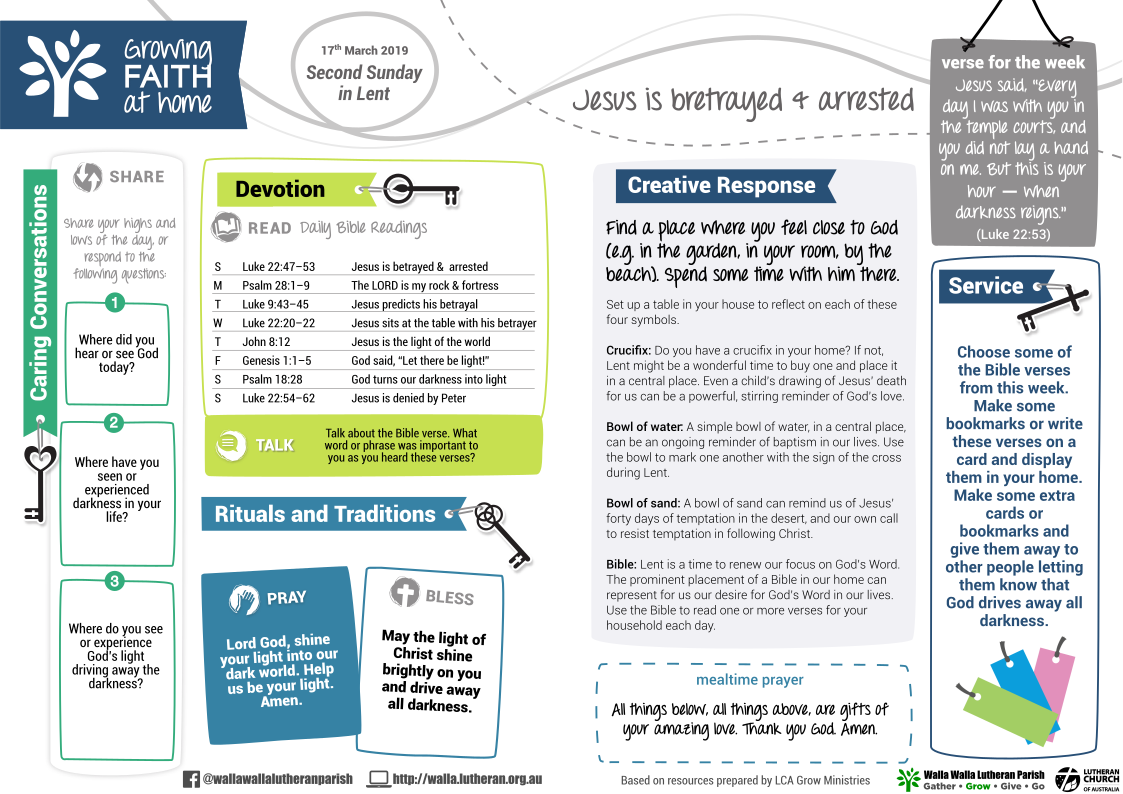
Lord God, shine your light into our dark world. Help us be your light. Amen.