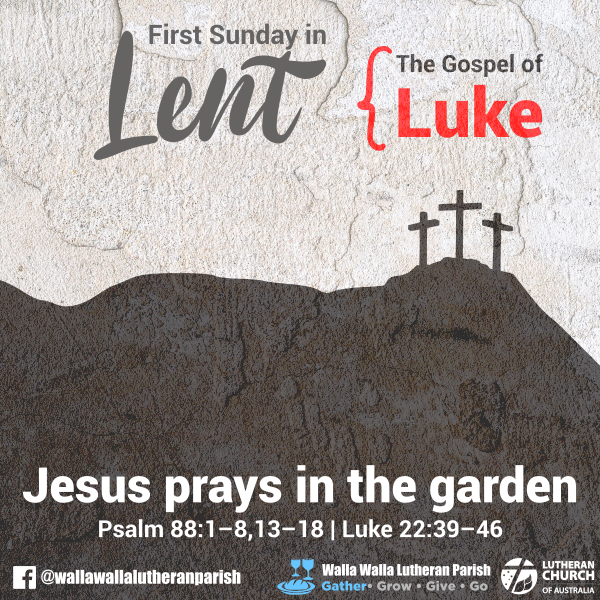
Today we’re going to explore the question: Why doesn’t God seem to answer our prayers to save us from trouble?
We pray: Heavenly Father, send us your Holy Spirit to open our ears to receive your preached word. You strengthened Jesus as he prayed in the garden, strengthen us through your word to life eternal. Amen.
Does God answer our prayers to save us from trouble?
Have you ever prayed to God to save you from trouble? Perhaps you were in the midst of a terrible situation. Maybe you or someone close was sick or in an accident. Did God save you from your troubles?
In our gospel reading Jesus begins and ends by encouraging his disciples to pray. “Pray, so that you might not fall into temptation.” He’s basically saying, “Pray that you don’t enter into a time of trouble.” So we’re definitely encouraged to pray to be saved from trouble. But there’s lots of evidence that God doesn’t always answer such prayers.
I have a painful personal experience of this. When I was about 24 my father was diagnosed with a terminal brain tumour. I prayed to God that he would be healed. I prayed I might not enter into a time of trouble. But my dad wasn’t healed. He died about 6 months after the diagnosis. Why didn’t God answer my prayer?
The psalmist who composed our psalm (Psalm 88) seems to have been in a similar situation. He starts off strong, “You are the God who rescues me.” But then it seems to go downhill, “I am overwhelmed with troubles. You have put me in the lowest pit. All day long your terrors surround me like a flood. Darkness is my closest friend.” And that’s where the psalm ends! The psalmist is left in the dark, in the midst of his troubles, crying out to God.
And it’s the same with Jesus. After encouraging his disciples to pray to be spared from trouble, he goes a stone’s throw away and prays about his upcoming troubles. “Take this cup from me!” he prays. The “cup” is the cup of suffering. It’s an Old Testament picture for God’s wrath, for troubles and trials and temptations. The prophet Jeremiah writes, ‘The God of Israel, said to me: “Take from my hand this cup filled with the wine of my wrath and make all the nations to whom I send you drink it. When they drink it, they will stagger and go mad because of the sword I will send among them.”’ (Jeremiah 25:15–16). Jesus has been asked to drink this cup of suffering and so he wrestles with his troubles. He’s filled with ‘anguish,’ or literally ‘agony.’ Like a wrestler struggling against an opponent, Jesus is covered in drops of sweat like blood. (This is probably a reference to the medical condition known as hematidrosis — when the blood vessels that feed the sweat glands rupture due to physical or emotional stress). But does God rescue Jesus? No… The answer to his plea, “Take this cup of suffering from me,” is for Jesus to be arrested, tried, sentenced to death, and crucified on a cross like the worst criminal.
Why doesn’t God seem to answer our prayers to save us from trouble?!
Grappling for an answers
There are a few points we can made as we grapple with this question.
First, God is not a vending machine. Prayer is not about bringing our list of requests to God, and then expecting him to fulfil them. God desires relationship, not just a list of requests to be fulfilled. [Video clip]. God yearns for us to cry out to him, as a child cries out to their father, because he wants us to know him. God desires that we rely on him and trust him, no matter the circumstances. The prayer Jesus prays in the garden ends with a statement of trust: “Take this cup of suffering from me; yet not my will, but yours be done.” (Luke 22:42).
Second, God has only partially revealed himself and his will; the rest is hidden to us. To distinguish this Martin Luther used the names the “hidden God” and “revealed God.” There is one God, but he’s so big and incomprehensible that finite beings like us can’t fathom his depth and mystery. The “hidden God” is an iron wall we can’t penetrate. The “hidden God” is terrifying. Take the situation in Psalm 88. The psalmist says that God put him in the pit. God’s wrath is heavy on him. God’s terrors have destroyed him and surround him like a flood. Or take Jesus’ situation. In this wresting match that takes place in the garden, Jesus comes to the realization that God’s will aligns with Satan’s will! God ends up saying, “Go along with what Satan wants. Do what Satan wills. Be arrested, tried, sentenced to death, tortured and crucified.” What a monstrosity! How can God will these terrible things?! Sometimes we might think, “God’s just testing me. He’s using this trial or trouble to grow my faith.” In some situations this approach may be helpful. But often it leads to the same place: God did or allowed this terrible thing to happen just to test me?! Doesn’t that make him a monster?! This is the “hidden God” that we can’t understand. Trying to understand the “hidden God” is futile, like trying to climb a smooth iron wall that extends to infinity. Instead we’re called to cling to the promise the revealed God has given to us, we’re called to cling to the person of Jesus. Jesus reveals to us who God is: God is our Father (Luke 11:2); God listens to us (Luke 11:9–10); God is good (Luke 11:11–13); and that God is with us (Luke 1:28). In the situations we don’t understand, we cling these promises. We cling to Jesus who cries out from the cross, “My God, my God, why have you forsaken me?” (Mark 15:34).
Third, God is with us in the midst of suffering to comfort and strengthen us. Yes, we can pray for God to help in our time of trouble, Jesus and the psalmist tell us to cry out to God for help. But God might answer our prayer with a “no” — “No, not your will, but my will,” he says. And yet, even this “no” brings comfort and strength. It means that God is aware of our situation. There is nothing happening in the world that he is not aware of and on top of. This week my task list got out of control. I seemed to have a flurry of phone calls and emails that added and added the list of things I had to do. And some of them fell through the gaps and didn’t get done. I wasn’t on top of everything. A bit like the disciples who fell asleep instead of praying. In contrast, God is always on top of things. He never sleeps. He’s with you. He speaks his Word to comfort to you. He gives his Holy Supper, food to strengthen the troubled traveller walking on the tough and rocky road. God might even send an angel to strengthen you, as he did for Jesus. But the angel didn’t whisk Jesus away from his troubles. Rather the angel strengthened Jesus while he was trapped down in the pit.
Last, we have the hope of new life. Jesus trusted God. He didn’t throw away his faith because the “hidden God” is incomprehensible. Instead Jesus cried out to God from the pit. God didn’t take the cup of suffering from Jesus in this case, but asked him to drink it and to trust him. And what happened? God raised Jesus from the tomb. God gave Jesus new life. And God promises this new life to you too. As God comforts and strengthens you, he also gives you the hope of new life. A life without tears. A life with new, perfect bodies. A life free from pain and suffering and troubles. What an amazing hope!
Challenge
Our challenge for this week is to pray. “Pray that you do not fall into temptation.” Pray that you may not enter into a time of trouble or suffering. If you’re not in a time of trouble at the moment, give thanks to God! Look for ways to bring God’s comfort to those who are in trouble. Don’t fall asleep like the disciples, but pray as Jesus prayed.
If you are in a time of trouble, cry out to the Lord. Ask him to reveal his presence to you. Don’t reach for the “hidden God,” but cling to the revealed God. Cling to Jesus who has entered the pit with you. Hold his body and blood in Holy Communion. Open your hands to receive his strength. Look for the angel that God may send to comfort and strengthen you.
And may the peace of God which transcends all understanding guard your hearts and minds in Christ Jesus our Lord. Amen.