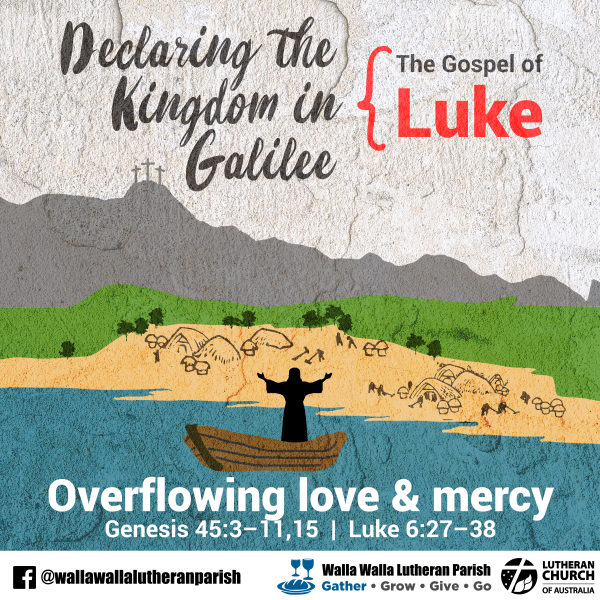
In our gospel reading, Jesus continues the so-called “Sermon on the Plain.” This section is all about love. He opens with a bold statement, “Love your enemies.”
Who are your enemies?
I was thinking about my enemies. I’m not sure I have any… Batman has enemies: Joker, Riddler, Penguin, Catwoman. Maxwell Smart from CONTROL has enemies: Siegfried and the Claw from KAOS. Joseph had enemies: his brothers were out to harm, perhaps kill, him.
Who are my enemies? Who’s wishing me harm? Who’s trying to kill me? Jesus’ command almost seems irrelevant to me…
But what if we soften this a little? Who rubs you the wrong way? Who annoys you or makes life difficult? Ahhh. These are my ‘enemies.’
What does love look like?
Jesus gives the command to “Love your enemies.” So what does this “love” look like?
We hear the word “love” and often think of red hearts, cupid, and roses. But “love” isn’t some airy-fairy concept. Love is concrete actions.
Jesus gives a very clear picture of what love looks like:
- Do good.
- Pray.
- Bless.
- Lend without expecting repayment.
- Be merciful.
- Don’t judge.
- Don’t condemn.
- Forgive.
- Give.
These are all active statements. The old saying is true, “Love is a verb.”
However, notice what love is not. Love doesn’t mean liking your enemies. Love doesn’t necessarily mean hanging out with them on the weekend. Rather, it’s about putting their well-being first. Putting their feelings and opinions above your own.
How can I love my enemies?
Jesus’ call to love your enemies is not easy. Some people are more lovable than others, aren’t they? ‘Enemies’ are, by definition, people you find difficult to love.
Jesus says as much when he declares, 32 “If you love those who love you, what credit is that to you? Even sinners love those who love them. 33 And if you do good to those who are good to you, what credit is that to you? Even sinners do that. 34 And if you lend to those from whom you expect repayment, what credit is that to you? Even sinners lend to sinners, expecting to be repaid in full. 35 But love your enemies.” (Luke 6:32–35).
Loving your enemies is more than a reciprocal relationship. Let me illustrate what I mean. If someone gives you a cup full of grain, and then you give them a cup full of grain back, that’s pretty easy isn’t it? The measure is equal. Even ‘sinners’ do that. Even unbelievers do that. This is in fact how the world operates. You give me something and I’ll reciprocate.
This reciprocation is the default position for humans. You only need to observe children playing for a short time to see it bubble to the surface. “She started it! She hit me first.” Our human nature wants everything to be equal. You might have heard the expression “tit-for-tat.” “I’ll do this for you, and then you do this for me.”
But Jesus calls his disciples to show love in unequal measure. The type of love he advocates breaks this “tit-for-tat” cycle. He says, “If someone slaps you on one cheek, turn to them the other also. If someone takes your coat, do not withhold your shirt from them.” (Luke 6:29).
God is a very bad accountant. His accounts do not balance. Our human nature wants everything to be equal. “I’ll give you one cup of grain, and you give me back another.” In contrast to us, God is utterly selfless. He gives and gives and gives, until it’s overflowing. His love and mercy overflows.
Jesus is the embodiment of God’s love. Jesus preaches this sermon on the plain not merely with words, but with his whole life. St Paul’s says, ‘God demonstrated his love for us, while we were still sinners Christ died for us.’ (Romans 5:8). When you were God’s enemies, Jesus loved you. And not in some airy-fairy way, but through concrete actions.
- Do good — Jesus heals the sick, and comforts the needy.
- Pray — Jesus prayed for his enemies as they were crucifying him on the cross (Luke 23:34).
- Bless — Jesus blessed all sorts of people. Remember the start of this sermon? “Blessed are the poor” (Luke 6:20–22).
- Lend without expecting repayment — Jesus paid for your sin, but doesn’t expect payment in kind.
- Be merciful — Jesus showed compassion and mercy to a crowd of people numbering 5000 who were hungry (Luke 9:10–17).
- Don’t judge — Jesus saved a woman from being stoned to death (John 8:1–11).
- Don’t condemn — As the gospel of John says, ‘Jesus didn’t come to condemn the world, but save it’ (John 3:17).
- Forgive — Jesus says “Your sins are forgiven” a number of times throughout the gospels.
- Give — Jesus gave up his life, pouring himself out saying, “This cup is the new covenant in my blood, which is poured out for the forgiveness of sins.”
Through Jesus, God gives us “a good measure, pressed down, shaken, and overflowing” (Luke 6:38). This is an illustration of God’s love for you. He fills the cup with grain, presses it down, shakes it to make more room, then adds more until it’s overflowing! We give in equal measure, but God gives in unequal measure. God’s love and mercy is overflowing. It’s from this overflow that we can give to others.
Why are we commanded to love?
This sort of love makes no sense to non-Christians. For a non-Christian who is honest with themselves, life boils down to the “survival of the fittest.” There is no incentive to give anything more than an equal measure. I believe that when a non-Christian gives, they always expect something in return. The something in return can be subtle i.e. giving to a charity returns a good feeling, or giving so that they will be remembered e.g. Bill Gates. The giving is always in equal measure with an expected return. One cup for one cup.
Adding God into the equation changes things. There’s a new source of grain. Through Jesus, God gives to you more than you can contain. In turn, this love can be given to others in unequal measure, especially to our ‘enemies.’ There might even be times they accuse you of having an ulterior motive, because they simply can’t understand it! Imagine the impact this love will have on your enemies… They’ll be led to ask, “Why are you treating me this way?” And that’s your window to tell them about the love and mercy that God abundantly pours into your lap. God’s overflowing love has the potential to change the fabric of society!
Challenge: this week I encourage you to consider who your ‘enemies’ are. Who rubs you the wrong way? How can you share the love that God abundantly pours into your lap?
God of mercy, let us follow the way of Jesus, so that we may overflow with your love & mercy. Amen.