
Group characteristics
We are part of many groups, each with their own characteristics.
I think of the groups at my high school. For example there was the “in” group. Insiders were tall or strong, played on the rugby or netball team, and exercised at the school gym in the morning. If you weren’t one of the top sports players, or had chosen maths as an elective, it seems you were excluded. For some, even myself at times, it seemed the goal of high school was to be admitted to the “in” group.
Think about a group you are part of. It might be a sporting group, a friendship group, even your family. What characteristics make up the members of your group? What do all the insiders have in common?
Insiders and outsiders in Jesus’ day
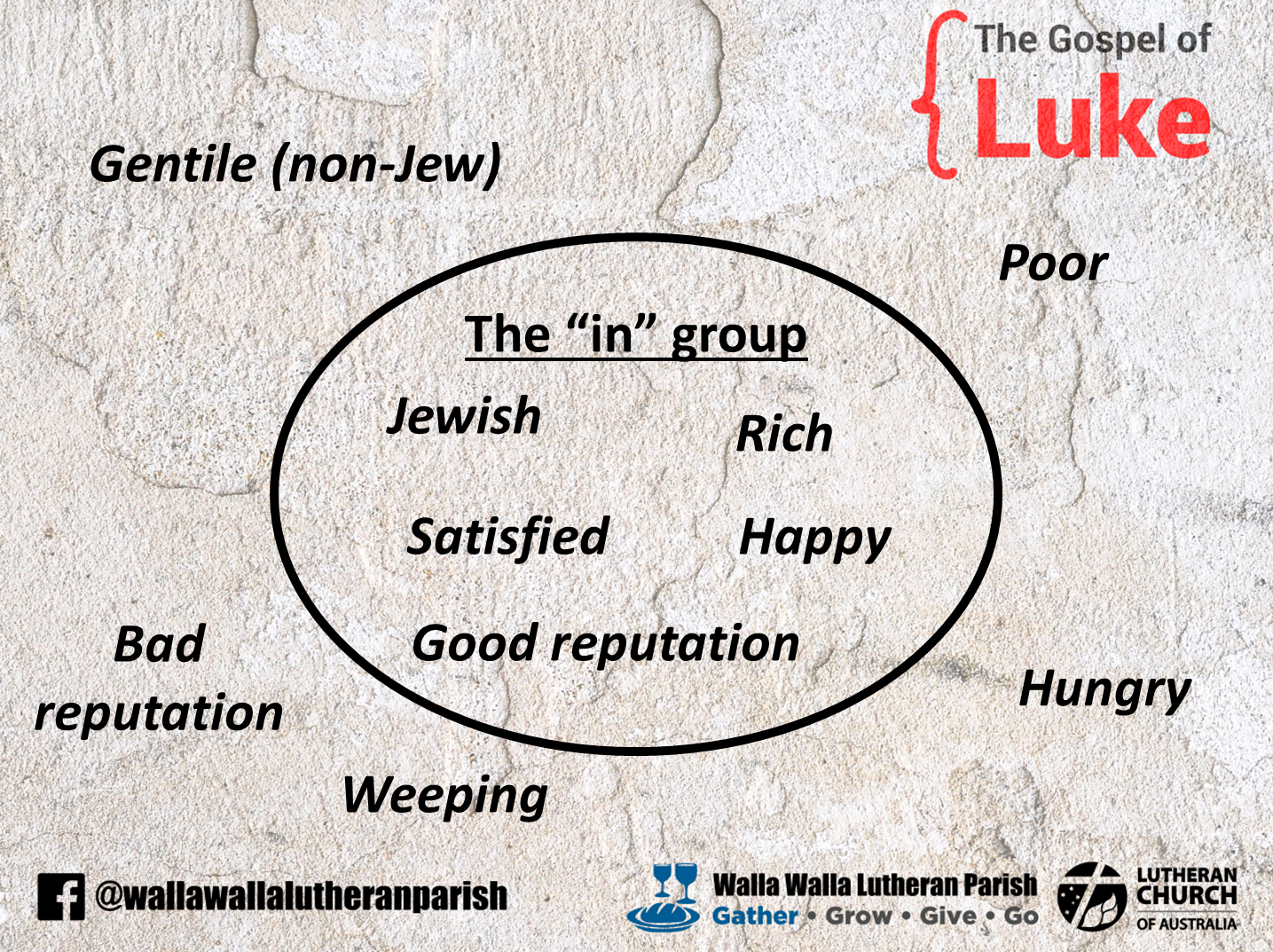
Organising ourselves into groups is human nature. There were groups in Jesus’ day. In fact they had a very strong definition of inside/outside, which is one of the main themes for the entire Gospel of Luke.
To be an “insider” you were:
- A good Jew, born into the right family.
- Rich — afford monetary offerings to God, paid the temple tax.
- Satisfied — had enough food to bring your excess grain, meat, and wine as offering to the temple or synagogue.
- Happy — looked like everything was going right in your life.
- Good reputation — had a good standing in the community.
The “insiders” were often called “the Pharisees” or “the Jews” and included sub-groups such as “the teachers of the law.”
By contrast the “outsiders” were:
- Gentiles (non-Jews).
- Poor — couldn’t afford to participate in the temple rituals.
- Hungry — didn’t have excess food for offerings.
- Weeping — widows, beset by terrible calamity or sickness.
- Bad reputation — criminals, immoral behaviour, “unclean.”
The “outsiders” were often called “the poor” or “sinners,” and included sub-groups such as “lepers,” “tax collectors,” “Romans,” “prostitutes.”
If you lived in Jerusalem and the surrounds at that time, the goal of life was to become one of the insiders, and stay there once inside.
Blessing and woe
In our gospel reading (Luke 6:17–26), Jesus talks about “insiders” and “outsiders.”
Jesus has been praying on a mountainside, but he’s come down to a ‘level place’ or ‘plain.’ He has a time of ministry where a large group of (predominately) “outsiders” crowd around him. They try to touch him so that his power can heal them. (Side note: someone on the inside would never allow an outsider to touch them.)
Then Jesus begins a long sermon (it continues all the way to the end of Luke chapter 6). He begins by, ‘Looking at his disciples’ (Luke 6:20). Jesus looks at his followers, he looks directly at you and me. Then he opens his sermon with four “blessings” and four corresponding “woes.”
Blessed are you who are poor.
Blessed are you who hunger now.
Blessed are you who weep now.
Blessed are you when people hate/exclude/insult/reject you.
But woe to you who are rich.
Woe to you who are well fed now.
Woe to you who laugh now.
Woe to you when everyone speaks well of you.
(Luke 6:20–26)
This was mind blowing to the people of the day. Jesus says to the insiders “woe to you,” and to outsiders “blessed are you!” Jesus has come for the outsider. He’s come for the poor and marginalised. He’s come to bless those on the fringe of society, those excluded from entering God’s presence at the temple. He’s come to feed, comfort, heal their sickness, to love and include them, to show that God is with them. Basically he’s turning Jewish society inside-out.
Some of you might have had this experience of being on the outside. One of the main themes of Luke’s Gospel is that Jesus has come to outsiders. But more than that: Jesus has come as an outsider. He became poor, coming as a baby in a manger (Luke 2:4–7). He was hungry in the wilderness (Luke 4:2). He wept over Jerusalem (Luke 19:41). He was rejected (Luke 20:15) and insulted (Luke 23:32–39). But in all of this he was also blessed by his heavenly Father. The good news comes between the four blessings and woes. Jesus says, “Rejoice in that day and leap for joy, because great is your reward in heaven” (Luke 6:23). On Easter day Jesus leapt up in joy from the grave as he was raised to a blessed new life. And we too can leap for joy.
Are we a group of insiders?
But despite this good news, as I was meditating on this text this week, I became very uncomfortable. I came to feel that I have become an “insider.” And that we — Walla Walla Lutheran Parish — are “insiders.”
- Many of us are “good” Lutherans, or at least born into “good” Christian families.
- We’re incredibly rich — depending on the measure, in terms of wealth, we’re in the top 1% to 15% of the global population.
- We’re well fed and satisfied — per person Australians consume about 100 kg/year of meat, compared to say 5 kg/year in India; I can’t remember the last time I was physically hungry.
- We are (mostly) happy — things are going well, we’ve just celebrated 150 years, there’s smiles and laughing.
- We have a good reputation — collectively we hold large parcels of fertile farming land, and own important businesses.
But Jesus looks at us, his disciples, and he says, “Woe, woe, woe, woe.” Woe to the rich. Woe to the satisfied. Woe to those who laugh. Woe to the well-respected.
Being turned inside-out
What on earth is going on here? How can we understand Jesus’ words to us? I think that, just as Jesus turned the Jewish community inside-out, Jesus wants to turn our community inside-out. Let me explain.
First, we can abuse our “insider” status. In our baptism, Jesus includes us into God’s family. We’re changed from being an “outsider” to an “insider.” But like the “insiders” of Jesus’ day, it’s all too easy to fall into the trap of excluding others. As Jeremiah says, our hearts are sick. We forget what it’s like to be excluded. Or, if we’ve grown up in the church, being an insider is all we know. We start associating only with other insiders. We use insider talk, big church words like “redemption,” and “sacrament.” We focus on ourselves, our needs, our wants. The good news is that Jesus came as an outsider to heal you and me. In worship, through Holy Communion, you gather around Jesus, touch his body, and his power heals. His body and blood is like medicine that cures the disease of “keeping-the-gospel-for-us-insiders-itis.”
Second, Jesus turns our group inside-out. Just as Jesus came for outsiders, Jesus propels us out of our insider group to those who are outside. We are rich in the gospel, we are filled and satisfied by the bread of life, we rejoice because of what Jesus has done for us. So let us take this good news to the poor and hungry, those who are weeping, and those hated, excluded, and rejected by the world.
I wonder who we exclude from our fellowship? Who have we forgotten? Who are the “outsiders”? Recently I’ve been thinking about two groups of people: (1) children and young people, (2) those who have dropped away from church (whether through a bad experience, or a perceived lack of relevance to their everyday lives). How might Jesus be healing and changing us so we can include them in our fellowship? How might we welcome them as Jesus welcomes us?
Warning: just as Jesus was ridiculed and rejected as he sought to include outsiders, the same will inevitably happen to us. As we speak up for those outside our circle, we too will be excluded and ostracised. Just as Jesus bore the cross, we too have our own crosses to bear.
A blessing as you are sent: May the Lord heal our sick hearts which often seek to be on the inside. May our hearts weep for the poor and marginalised, as Jesus weeps. May God give us a hunger to bring the good news to those who are excluded. May we boldly confess our faith through action, to the extent that we will be excluded, insulted, and rejected because of Jesus’ name. Amen.