Series introduction
Sometimes to know what something is, you need to know what it is not. In our new series we will ask the question, “What is the gospel?” We’re going to explore some great heresies of the church. A “heresy” is a false teaching about a fundamental truth of Christianity and Jesus. As we explore these false teachings, we’ll come to a deeper understanding of the good news that Jesus died, was buried, and rose again for the forgiveness of your sin — this is the gospel!
This approach — working out what something is by what it’s not — is very common to the Christian faith, and in particular the Lutheran tradition. You may be aware that Lutherans subscribe to the Book of Concord. Many of these historical confessional documents have a section “This is what we believe,” but also a section “This is what we reject” or “These are false teachings to avoid.”
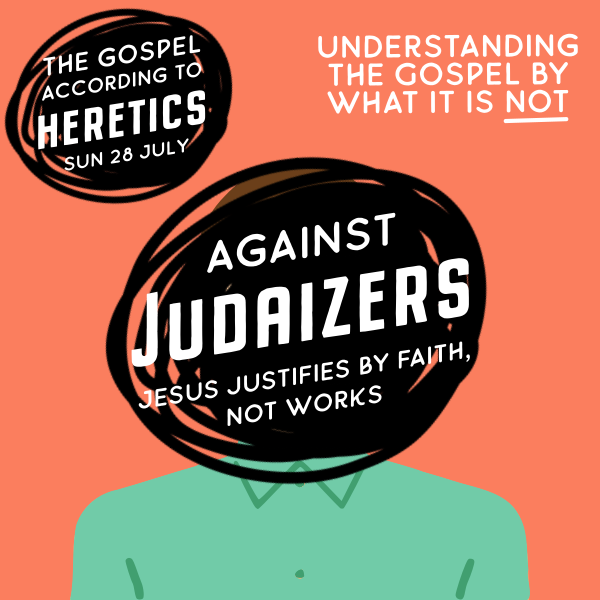
Today we’re going to explore the issue of “Judaizers” in the early church. Other topics we’ll cover will include Arianism and Docetism (which are about Jesus being both God and man), Pelagianism (about sin and human will), and lastly dualism (about the goodness of creation). “Judaizers” were a group of people in the early church who tried to corrupt the gospel by saying that what you do (“the works of the law”) makes you right with God. But the truth is that Jesus makes you right with God by faith alone, not by works.
Let us pray. Heavenly Father: send us your Holy Spirit to open our ears to hear your preached Word. May we hear the good news that we are not made right with you by our own works, but by your Son Jesus Christ. Comfort us by this promise to life everlasting. Amen.
The State of Theology
I want to show you a short segment of a video. A group in America interviewed some random people about their beliefs on God and salvation. Their responses are concerning. The answers they give seem to have been influenced by false teachings and wrong understanding about Jesus and the gospel.
‘The State of Theology’ by Ligonier Ministries (2016)
I think this video shows that the church has failed at proclaiming the truth of the good news of Jesus. The people in this video have missed the point of the gospel. If St Paul had interviewed them, I think he would say something pretty similar to what he wrote in Galatians:
You foolish [people]! Who has bewitched you? Before your very eyes Jesus Christ was clearly portrayed as crucified. I would like to learn just one thing from you: Did you receive the Spirit by the works of the law, or by believing what you heard? (Galatians 3:1–2)
These people in the video, to me at least, sound like they are relying on “works of the law.” They are relying on what they must do to save them.
What are “works of the law”?
To help us understand, let me tell you a story about early Christianity — the story of the Judaizers. Since day dot, the church has had problems. There have been trouble-makers and divisions. Even the first church in Jerusalem had problems, where Jesus’ closest disciples — Peter, James, and John — were the pastors and leaders. A group arose which said, “Hey, to be a Christian, to be right with God, you need to follow the law of Moses, you need to keep practising the Jewish customs. You must be circumcised. You must eat kosher food. You must observe the Sabbath and not do any work on Saturdays.” This group is sometimes called “Judaizers” (after the land of Judah) or the “circumcision party.”
Paul tells the story in his letter to the Galatians (chapter 2) that one day Peter was visiting Paul and his friend Barnabas in Antioch (in ancient Syria, modern day Turkey). Each day they were all eating together, talking, hanging out. But then this group of Judaizers arrived in town and Peter changed his attitude. Peter withdrew from the Christians who were not following the Jewish customs. He stopped eating with them, as if they weren’t ‘true’ Christians. Paul writes about his confrontation with Peter:
Peter’s actions were not honest. The other Jews joined him. Even Barnabas was led down the wrong path. I saw what they were doing. It was not in line with the truth of the gospel. So I spoke to Peter in front of them all. “You are a Jew,” I said. “But you live like one who is not. So why do you force non-Jews to follow Jewish ways?” … We know that no one is made right with God by obeying the law. It is by believing in Jesus Christ. Because of the law, I died as far as the law is concerned. I died so that I might live for God. I have been crucified with Christ. I no longer live. Christ lives in me. … What if a person could become right with God by obeying the law? Then Christ died for nothing! (Galatians 2:13–21, selected verses)
The “law” is God’s Word that has demands, conditions, or threats. “You must do this.” “You shall do that.” “If you do this, then this will happen.” The following statements are often rightly heard as law: “You must love the Lord your God with all your heart.” “You shall not murder.” “Unless you repent you will perish.” No one can meet these demands or satisfy these conditions. No human can keep or fulfil the law. The law leads to one place, and one place only — death. The law is like a black hole that sucks everyone to the singularity of death. It even sucked Jesus (willingly) to his death.
As St Paul writes: ‘For all who rely on the works of the law are under a curse, as it is written: “Cursed is everyone who does not continue to do everything written in the Book of the Law.” Clearly no one who relies on the law is justified before God.’ (Galatians 3:10–11).
If you live by the law you must follow it perfectly, every last dot of the “i” and cross of the “t”. But the problem is, you can’t. You have not followed God’s rules and commands. “You must love the Lord your God with all your heart.” Fail! “You shall not murder.” Fail! (You might say “Well I haven’t murdered anyone.” But Jesus says that anyone who is angry is guilty of murder (Matthew 5:21–22). Have you ever been angry? Fail!) “Unless you repent you will perish.” Have you truly and sincerely repented and turned from your sin? How can you know? Surely if you’ve sincerely repented you wouldn’t sin again… Fail!
What is the gospel?
The gospel is that Jesus Christ has done what you fail to do. St Paul proclaims the gospel when he says: ‘Christ redeemed us from the curse of the law by becoming a curse for us, for it is written: “Cursed is everyone who is hung on a [tree].”’ (Galatians 3:13). The gospel is that Jesus Christ died for you. You deserve the curse, but Jesus became a curse for you and hung on a tree. You deserve death, but Jesus died for you on the cross. The law always leads to death. And in one sense you have died. That is why St Paul says you have been ‘crucified with Christ.’ In baptism you die. You are plunged under the water and your old self is drowned. But Jesus Christ was raised to life. And just as you died with Christ, so too you are raised from the waters of baptism to new life.
The only “work” we can contribute to our salvation is to have faith (and that’s not really our work either, because God gives us this faith!). As Jesus says in John chapter 6, “The work of God is this: to believe in the one he has sent.” (John 6:29). Faith just means to trust or believe what Jesus says. And Jesus says, “Your sins are forgiven.” “I have come that you may have life.” “I will give you rest.”
What’s the problem with Judaizers?
The first problem is that the gospel is a stake. There’s nothing wrong with obeying God’s law and commands. The law is good. But the problem is when we think obeying laws will make us right with God. If we think what we do contributes to our salvation, then we have a problem. This is what the Judaizers were saying. “To be saved, you must be circumcised. You must eat kosher to be a Christian. Etc.” These are statements of law. And no-one is saved through the law. The Judaizers were trying to add something to the gospel.
The second problem with the Judaizers adding to the gospel, is that it creates anxiety for Christians. The law is never satisfied, so you are always filled with questions and doubt and anxiety. “Have I done enough?” “Am I good enough?” “Have I pleased my heavenly Father enough?” The gospel puts an end to these anxious questions and doubts. You haven’t done enough, but Jesus has. You have not pleased your heavenly Father enough, but Jesus has.
What do Judaizers sound like today?
Judaizers still exist today, but don’t quite sound the same. They’re not going around saying, “You need to be circumcised and eat kosher to be a Christian.” I think we heard what Judaizers sound like today in the video we saw earlier. Some of the responses were as follows:
“Do you believe you’re going to heaven?” “Not sure but I do my best!”
“How good would you have to be to get into heaven?” “I believe there are steps to get there.”
“Do you believe you contribute anything to your going to heaven?” “Yeah. I try to make sure I make some sort of impact on people every day.”
“How would you react if I were to tell you that your salvation doesn’t depend on your works, but on what Christ has already done?” “Well I can agree with that, but it also depends on how you live your life, and if you follow God’s guidelines.”
We might also hear the false gospel of Judaizers when someone says, “I need to clean myself up before coming to God.” Or sometimes people might say, “If I step inside a church building, it will fall down on top of me.” These are all subtle versions of the false gospel of Judaizers — that your works, your life, what you do, contributes to how God sees you.
We can also hear Judaizers in some other Christian traditions, which might say, “You must speak in tongues to be a true Christian.” Or, “You must be baptised as an adult to be truly saved.” These too are subtle versions of this gospel.
A family illustration
Let me close with an illustration to sum up. Imagine a husband and wife, who have adopted a child. The parents have decided on certain rules or laws for their household, to keep the family safe and enjoy life. “You must not use matches inside the house.” “You shall always tell someone where you are going and when you’ll be back.” “If you wear dirty shoes into the house you will mop up the mess.” These rules are good. They protect the child. They help the household to run smoothly. But do these rules make the child part of the family? If the rules are broken, does the child stop being family? No! The child is part of the family because she has been adopted by the parents. The child loves and trusts her parents.
Likewise, it’s not following God’s law that makes you his children. The good news of the gospel is that Jesus makes you right with God through his death and resurrection. This, and nothing else, makes you right with God.
Let us pray. Heavenly Father: Jesus Christ has set us free. Help us to walk by the Spirit, living by faith, not works of the law. Amen.