There are a variety of religious rituals that exist across the globe. Take for example the Fire Festival in one Japanese village. A small group of villagers build an 18 metre high tower, a shrine to their god. As an offering, the village people set fire to the shrine. But the 25 and 42 year old males (the “unlucky years”) are tasked with defending the shrine from being burnt. It’s a fascinating ritual.
https://www.facebook.com/watch/?v=965223613684758
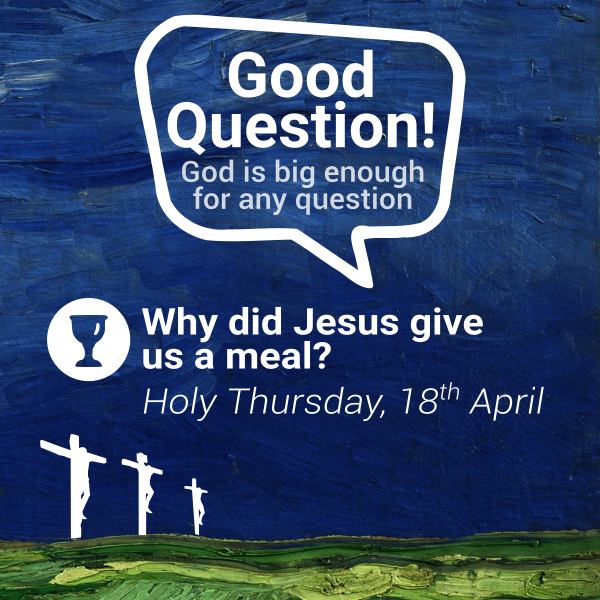
Jesus could have given us any number of different spiritual rituals: a song, a special greeting, a dance, defending a shrine from burning. But instead he gave us a meal. Holy Thursday remembers and celebrates that Jesus gathered his disciples on Thursday evening and ate a meal with them. But why exactly did Jesus give us this meal? I think for a few reasons.
(1) To remember. This meal has its roots in the Jewish feast of the Passover. The Jews celebrated the Passover to remember what the Lord had done, rescuing his people from slavery in Egypt by parting the Red Sea. But Jesus changed this Passover meal. He took bread saying, “This is my body.” He took one of the cups at the table saying, “This is my blood.” And he said: “Do this in remembrance of me.” Remembering means more than recalling the events in our mind. The act of remembering actually forms our identity. To remember links the past, present, and future together. The recital of the words, the repetition of the actions, allow ourselves to travel in time to the past, as it were, to be “there” in the saving actions. We are also together with Christ in the present. And we look forward to the new possibility of being transformed in the future. By giving us this meal to remember, Jesus is forming our very identity and shaping who we are.
(2) To commune with each other. We hear that Jesus and his disciples were ‘reclined at the table.’ Meal tables are a place to be with each other and practice hospitality. Author Michael Frost says: ‘The table is the great equalizer in relationships. When we eat together we discover the inherent humanity of all people. We share stories. And hopes. And fears. And disappointments. People open up to each other.’ A table represents hospitality, generosity, unity. In fact sharing a meal around a table mirrors the heart of God himself. One theologian said: ‘Hospitality is an attitude of the heart which is about openness to the other. … This mirrors the hospitality of the Trinity as God chooses to open himself to the other through the Incarnation and to subject himself to the created order.’ (Janice Price). By giving us this meal, Jesus shows us God’s hospitality and generosity, and invites us to become like God among each other.
(3) To help us understand Jesus’ death. It’s common for people to make speeches at meals. For example, I was the best-man at my brother’s wedding and I gave an embarrassing speech at the dinner (if I remember I think I warned his new wife that she’d just married a big kid!). At the Last Supper, Jesus gave a speech that helps explain his death. It wasn’t just any old speech, but his last will and testament. A ‘testament’ is a promise made by someone who’s about to die. It does two things: (a) designates an inheritance, (b) identifies the heirs. Jesus designates the inheritance when he says, “for the forgiveness of sins.” This is what we inherit when Jesus dies. Jesus identifies the heirs when he says, “for you.” You inherit the forgiveness of sins through Jesus’ death. And it is this meal, and this speech at the meal, which helps us understand. By giving us this meal, Jesus makes sense of his death.
(4) To give us what we need. We eat and drink to receive what we need: nutrients, energy, the elements required for life itself. Think about what you ate yesterday. Without these nutrients you wouldn’t have the energy or strength to breathe, to have travelled here tonight. Likewise the Lord’s Supper nourishes, giving what you need: forgiveness of sins. The meal doesn’t just help us understand Jesus’ death, but we actually receive the benefits of his death. But how can eating and drinking the bread and wine do such amazing things? Martin Luther answers this question in the Small Catechism: ‘The eating and drinking do not in themselves produce [anything], but the words “for you” and “for the forgiveness of sins.” These words, when accompanied by the bodily eating and drinking, are the chief thing in the sacrament, and [the one] who believes these words has what they say and declare: the forgiveness of sins.’ By giving us this meal, God grants us what we need more than anything else in the entire world: the forgiveness of sins.
So this event that Jesus instituted isn’t just any old spiritual ritual. It’s not just an ordinary meal. Rather Jesus gave us this meal for us to remember and shape who we are. Jesus gave us this meal so we commune with God and each other in hospitality and generosity. Jesus gave us this meal to make sense of his death. And Jesus gave us this meal so we can receive what we need: the forgiveness of sins. May you eat and drink this meal often, with joy and thanksgiving. As you gather around the table tonight, may you remember, commune, understand, and receive. Amen.