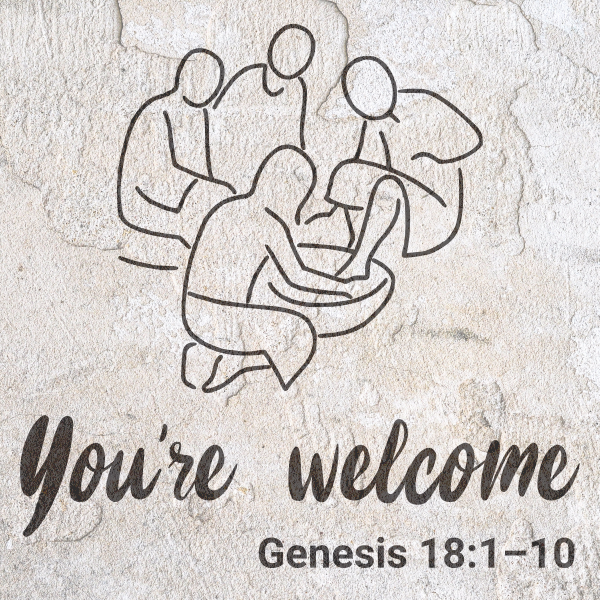
I’d like you to think about a time when you have been welcomed as a guest. What was it about the situation, or your host, that made you feel welcome? I remember vividly when our family moved here to Walla. We arrived at the manse (the pastor’s house) and the kitchen bench was covered with food. The fridge was well stocked with staples and special treats. There was even food in the freezer. What made us feel welcomed at this time was the unexpected surprise and the quantity of the gift!
In our reading, Abraham shows great generosity and hospitality. The story vividly sets the scene with just a few words. Abraham is ‘sitting at the entrance of his tent in the heat of the day.’ Abraham’s family is living in Canaan at the time — essentially a desert in the Middle East. With just these few words you can almost see the tent through the wavy heat lines of the scorching sun. This kind of heat is draining, you don’t want to be doing anything. Sitting at the entrance of the tent, by some trees, sounds like a good place to be! But Abraham’s not just resting from the heat, he’s also paying attention to his surroundings. He’s looking out. He soon notices three strangers, probably travellers from a foreign land. They didn’t belong there. They were different.
In the news recently we’ve heard about foreigners who supposedly don’t belong. This week, Donald Trump Tweeted about four congresswomen (dubbed “the squad”) telling them to “go back and help fix the totally broken and crime infested places from which they came.” If I understand him correctly, he’s essentially saying, “You don’t belong here. Go back to where you came from.” Later his supporters chanted “Send her back.” Doesn’t sound like Abraham at all! However, as the saying goes, those in glass houses shouldn’t throw stones. We here in Australia can hardly point the finger. “Operation Sovereign Borders” which seeks to “turn back the boats” essentially says the same thing. Recent advertising says, “No way. You will not made Australia home.” Again, very different to the response Abraham gives his visitors. I wonder how we treat visitors here in Walla/Alma Park? How do we treat those who are different from us? How do we treat those with a different history? Those who dress or live differently from us? Those who have different values or different ways of thinking?
Abraham is a great example to our Christian faith in the way that he treats these three visitors who are different. He doesn’t turn them away. In fact he doesn’t wait until they knock at the door and ask for hospitality. Instead he sits at the entrance, as if looking out for visitors. And when he sees them from afar, he hurries to meet them. He runs! Remember it’s the heat of the day. No one wants to do anything in that sort of strength sapping heat. Yet no exertion, even on behalf of total strangers, is too much where hospitality is concerned.
This reminds me of the Parable of the Lost Son (Luke 15). You may remember that after the son demands his inheritance and wastes it away, the forgiving father is scanning the horizon. ‘While [the son] was still a long way off, the father saw him and was filled with compassion for him. He ran to his son.’ (Luke 15:20). God is like Abraham and this forgiving father. In contrast to us, God is always on the lookout for strangers. He’s constantly scanning the horizon for you. God always hurries to welcomes you home.
Next in our reading we hear that Abraham bends low to the ground to greet the three strange travellers. ‘He hurried from the entrance of his tent to meet them. He bowed low to the ground.’ This gesture is one of humility. I wonder if our country’s leaders can learn something from Abraham’s example? I wonder if we can learn something? When meeting these strangers, Abraham doesn’t feel superior. Rather he makes himself inferior, bending low, bowing to them.
This reminds me of the so-called “Christ Hymn” in Philippians chapter 2. ‘Christ, being in very nature God, did not consider equality with God something to be used to his own advantage; rather, he made himself nothing by taking the very nature of a servant. … He humbled himself by becoming obedient to death — even death on a cross!’ (Philippians 2:6–8). Abraham’s hospitality points us to Jesus, the Christ. Christ too bends low, with his face to the ground. He became a human being on earth, just like you. More than that, he died on the cross for you. God always bends low to welcome you.
Then Abraham says, “Let me get a little water to wash your feet. Let me get you a morsel of bread to refresh you.” Abraham minimises his efforts. But instead of just a little water, just a crumb of bread, he hurries off and prepares a feast! He instructs Sarah to use three large measures of flour, enough for a week’s worth of bread for each guest! Then he instructs a servant to prepare a tender calf. Yet he doesn’t magnify his own actions. Generous people are in the habit of minimising their own efforts, for their deeds are bigger than their words. Boastful people do the opposite, they maximise their words, exaggerating their deeds, their words are bigger than their deeds.
Just like the meal Abraham freely offers his guests, Jesus offers you a meal to refresh you. But it doesn’t look like much, nothing more than a little wine and a morsel of wafer bread. Yet it is much more. As we dine around God’s table, we meet Jesus himself, his body and blood truly present. The Holy Spirit works through this feast to bring you forgiveness of sin, eternal life, and salvation!
Why did Abraham act like this? The readers know that these strangers are God (Genesis 18:1), but Abraham doesn’t know this (at least at first). So why is Abraham so generous and hospitable? Martin Luther, writing about this passage offers a few suggestions.[1]
(1) It’s what Abraham has been taught. God’s people, the church, has taught him to be hospitable. Luther writes, “There is hospitality wherever the church is.” I think this is our word of challenge today. Have we been taught hospitality? Are we generous? How can we be on the lookout for strangers? How can we hurry to them, bending low, and showering them with generosity?
(2) Abraham has experienced being a stranger himself. He’d left Ur and travelled through Egypt and then Canaan. As a stranger he would have at times been rejected, and other times received a hospitable welcome. We too have experienced generous hospitality. God himself looks out for us like Abraham and the forgiving father. You are different than God — you are unholy and sinful. And yet God the Father hurries out to meet you. He wraps his forgiving arms around you. He sends Jesus to earth as a human to die on the cross for you. He freely offers you the meal of Holy Communion to refresh you for your journey. Then, having experienced such hospitality, you are sent out to “go and do likewise”!
(3) Abraham has great faith that he was meeting God, Christ himself, in these strangers. Jesus says in Matthew chapter 25, “Whatever you did for the least of these, you did for me.” Whenever we feed the hungry, give drink to the thirsty, invite a stranger to come in, comfort prisoners, and visit the sick — it’s as if we receive the Son of God himself! Jesus himself is sitting in those boats trying to cross the rough seas to Australia. Jesus himself is walking through the door of this church, sitting in the pews bedside you, sharing Holy Communion with you. Jesus himself is knocking at your door, sitting at your table, eating with you. Will you welcome him? How will you shower hospitality upon him? If we really believed this, if we really believed that Jesus was present in our visitors, wouldn’t we rush to meet him? Wouldn’t we bend low to greet him? Wouldn’t we open up our houses and wallets and give it all to him? But we lack the faith. We are slow to perform these acts of love and service. Abraham’s faith is set before is as a mirror. It shows us that at times we are lazy, unwelcoming, inhospitable.
Let us pray for faith like Abraham. We ask that the generosity and hospitality of God the Father, Son, and Holy Spirit may make us new people. Keep your eyes open these next few days and weeks. Who are the strangers God is placing before you? Run to meet them, let nothing be too much effort. Don’t boast about your deeds, but humbly serve the needy. Tell them about the generosity God has shown to you. And as you serve them, may you encounter Christ himself. Amen.
[1] Luther’s Works AE 3:176–181