My very first overseas trip was to the USA. I was at university at the time and travelled to California to present at a conference. I remember disembarking from the plane tired, overwhelmed, and dazed. Like cattle we were herded into lines at the immigration control checkpoint. I finally reached the front of the line and the officer at my station started interrogating me. “Where have you come from?” he asked. “Ummm, the plane?” I stammered. He gave me a look. “Oh, from Brisbane, Australia,” I added. “What’s the purpose of your visit?” he continued as he reached for my passport. “Business, then some personal travel,” I said. He held up my passport to compare the photo with me. “And where are you going?” he asked.
Answers to the big questions
Following Jesus means having answers to all the questions that immigration officer asked. “Where have you come from?” “What’s your purpose?” And “Where are you going?”
These last few weeks we’ve heard where we come from: God is our maker and creator. Our purpose is to be his image: we are placed in the world to represent him, to be his hands and feet.
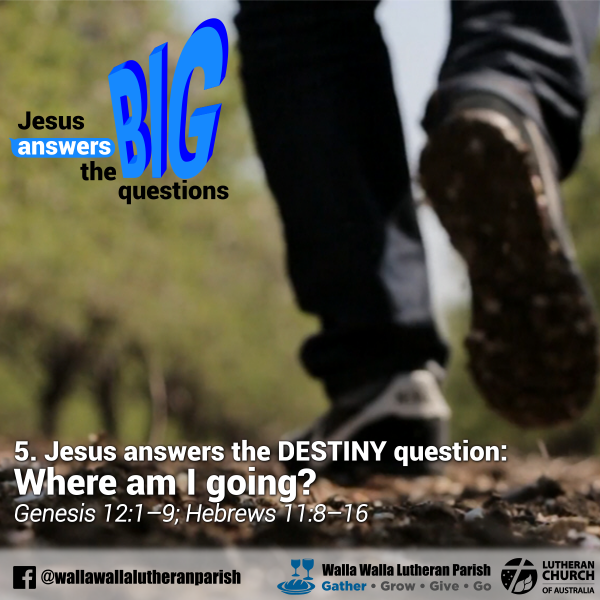
Following Jesus also means having an answer to the question “Where am I going?” “What’s my destiny?” “Where is the end point in this journey of life?”
1. You have a destination
Jesus answers the destiny question by telling you that you have a destination in the journey of life. Now by “destination” I don’t mean death (what’s that old saying: “the only two sure things in life are death and taxes”?). I’m saying that you have a destination beyond death.
The Bible reveals to us various aspects concerning this destination — the afterlife — but frustratingly it doesn’t reveal everything. Scripture uses various names: ‘the new heaven and new earth’ (Revelation 21), ‘the eternal or enduring city’ (Hebrews 11–13), and ‘my Father’s house’ (John 14).
The story of Abram and the promised land is an important parallel for helping us learn about the afterlife.
The LORD had said to Abram, “Go from your country, your people and your father’s household, to the land I will show you.” (Genesis 12:1)
God promised Abram that he would show him ‘the land.’ And like Abram’s promised land, God promises us that he will show us and lead us to our promised land. Jesus himself says this:
“My Father’s house has many rooms; if that were not so, would I have told you that I am going there to prepare a place for you? And if I go and prepare a place for you, I will come back and take you to be with me that you also may be where I am.” (John 14:2–3).
Like the promised land, the Father’s house is not visible — we can’t see it. So like Abram we must trust that Jesus will lead us there. Our destination is a promise and Jesus is the Way.
The author of Hebrews says it like this:
By faith Abraham, when called to go to a place he would later receive as his inheritance, obeyed and went, even though he did not know where he was going. (Hebrews 11:8)
So Jesus answers the question “Where am I going?” by telling you that you have a destination. But you need to trust in his promise that he will lead you there.
2. You have been bequeathed credentials to enter
When I arrived at that immigration checkpoint, the officer not only asked me where I was going, but he also checked my credentials: he looked at my passport.
Jesus promises that he’ll show you the way to your eternal destination, but what right do you have to enter? What are your credentials?
The story of Abram is again a helpful parallel. We read:
The LORD appeared to Abram and said, “To your offspring I will give this land.” (Genesis 12:7)
God promised to give the land to Abram’s offspring. So in order to inherit the promised land, one had to be an offspring and heir of Abram.
Likewise to receive eternal life, to enter the Father’s house, your credentials are that you are an offspring and heir of God. That’s your ‘passport’ as it were.
What’s interesting about these word pictures (‘offspring’ and ‘heir’) is that you can’t earn either one.
Let’s say I wanted to become someone’s offspring. No matter how hard I work or pay I can’t change who my parents are. No amount of hard yakka will make me the child of someone other than my own parents. You only become family when you are adopted into the family. This is why God promises to adopt you in baptism. In baptism God adopts you as his child, and you become a brother or sister of Jesus. In your baptism you are freely given the credentials to enter into everlasting life with God: you become a child of God.
It’s the same with an heir. The only way to become an heir and receive the inheritance is for a relative to die. The heir is given the inheritance through the last will and testament. Now Jesus, your brother through baptism, has died for you on the cross. And in his last will and testament Jesus bequeaths you his inheritance. A “testament” describes what happens when someone dies, which is why we call the parts of our Bible the Old and New Testament — the Bible tells us what happens when Jesus dies. Scripture tells you that Jesus bequeaths you new life after death.
Now we don’t tend to like talking about death in our society. We tend to avoid it. It’s only at certain checkpoints in life that we stop to think about the afterlife. Perhaps it’s a health scare, or the funeral of a loved one. As a pastor I have the privilege of meeting with people at these checkpoints. Yet it’s surprising how often I hear things like: “He’ll get into heaven because he’s lived a good life.” “She went to church every week so she’ll be okay.” “I’ll be right because I never broke a major commandment.” These might be nice sentiments, but they are not good credentials for the afterlife.
The only important credential is that Jesus is your adopted brother by baptism, that Jesus has died, and that he’s left you an amazing inheritance. All you need for your invitation to enter the Father’s house is to believe his words to you.
3. Your destination changes your journey
You might be saying, “That’s all well and good, but I’ve got years ahead of me. I’ll worry about all this afterlife stuff later.” That may be true, but in the meantime your missing out on the benefits that come from knowing where you are going. See knowing where you are going affects the entire journey.
Let me explain it this way. Imagine you’ve purchased one of those mystery holidays. You know the ones where you pay a cheap price, but you don’t know where you’re going until the last minute. Without knowing the destination, how do you know what to pack? Do you pack snow gear or flippers? And what will the journey be like? Will you fly or go on a bus? Without knowing the destination, you don’t know anything about the journey!
Your eternal destination is just like that. Knowing where you are going affects your life journey. It affects you right now.
- Firstly, knowing where you’re going means that you don’t need to lug around all sorts of baggage. Disciples of Jesus have a future with God forever, so that means there’s more to life than what we can see here and now. Life isn’t about amassing wealth or power or friends or prestige. You can’t bring any of that with you where you are going. So this knowledge changes how we live our lives today.
- Secondly, we’ve already heard that life isn’t about trying to earn entry into the afterlife. Attending church every week, receiving the Lord’s supper, praying every day: these things don’t earn your credentials. Don’t get me wrong, all these things are good! But having an answer to the question “Where am I going?” means that we understand why we do all these things. We come to church, we receive the Lord’s supper, and pray not to earn favour with God; but to receive strength for the journey.
That’s because, even though we know the destination, the journey is still difficult. It’s a blessing to know that you have a destination, but not every blessing is easy. Think about Abram again. He was promised a land, and offspring who would inherit this land. Yet he and his wife Sarah grew old; so old that it seems unlikely they would have children. So Abram decided to have a child with his Egyptian slave Hagar (Ishmael). Understandably this caused lots of friction in the family: the journey is not easy. Then on top of this, when God does grant them their miracle child (Isaac) God then asks Abraham to sacrifice his one and only child. The blessing is not easy!
The reason of course is that through the journey God is preparing you for your future with him forever. You are an heir, but you need to be tested and tried so that you become that heir. God is growing you through the journey of life. So knowing your destination helps you to understand the here and now.
Blessing
May you take time today to evaluate where you are going. May you use this checkpoint to understand that where you are going affects your life now. May you enjoy the journey of being and becoming the heir to your Father’s kingdom. May you inherit eternal life, not by your own works, but through the death and resurrection of your adopted brother, Jesus Christ. Amen.